


Ecommerce scaling is becoming a major challenge faced by online store owners in today’s world. With the eCommerce industry expected to pass $8 trillion in 2027, many eCommerce businesses are not ready for the changes that come with taking their business to the next level.
Scaling goes beyond sales increase; it is about creating functioning strategies, systems, and operations that can manage higher volume without offering poor customer service.

How To Boost Your Email Open Rates with a Good Cold Email Subject Line
By Javeria Riaz on August 13, 2025This article will show you how you can use exceptional customer service, marketing efforts, and brand marketing to take your business to new heights. You’ll also learn the tips to help you scale your eCommerce business while optimizing your time and resources.
Table of Contents
- The Difference Between Growth and Scaling
- Understanding Scaling in Ecommerce
- Core Foundations for Ecommerce Scalability
- How to Scale an Ecommerce Business
- Advanced Strategies for Scaling Your Ecommerce
- Signs Your Ecommerce Business is Ready for Growth
- Leveraging Marketing Strategies for Growing Your Business
- Common Challenges in Ecommerce Scaling
- Final Thoughts
- FAQs
Key Takeaways
- E-commerce scaling is mainly about sustainable growth. Scaling your eCommerce business requires handling more customers, sales, and operations without reducing business growth.
- Scaling and growth are entirely different. Successful scaling increases business revenue without having a proportional increase in cost, while growth adds resources that will lead to an increase in revenue.
- Building a strong foundation, customer retention, technology, and operations is very important before you scale your online business.
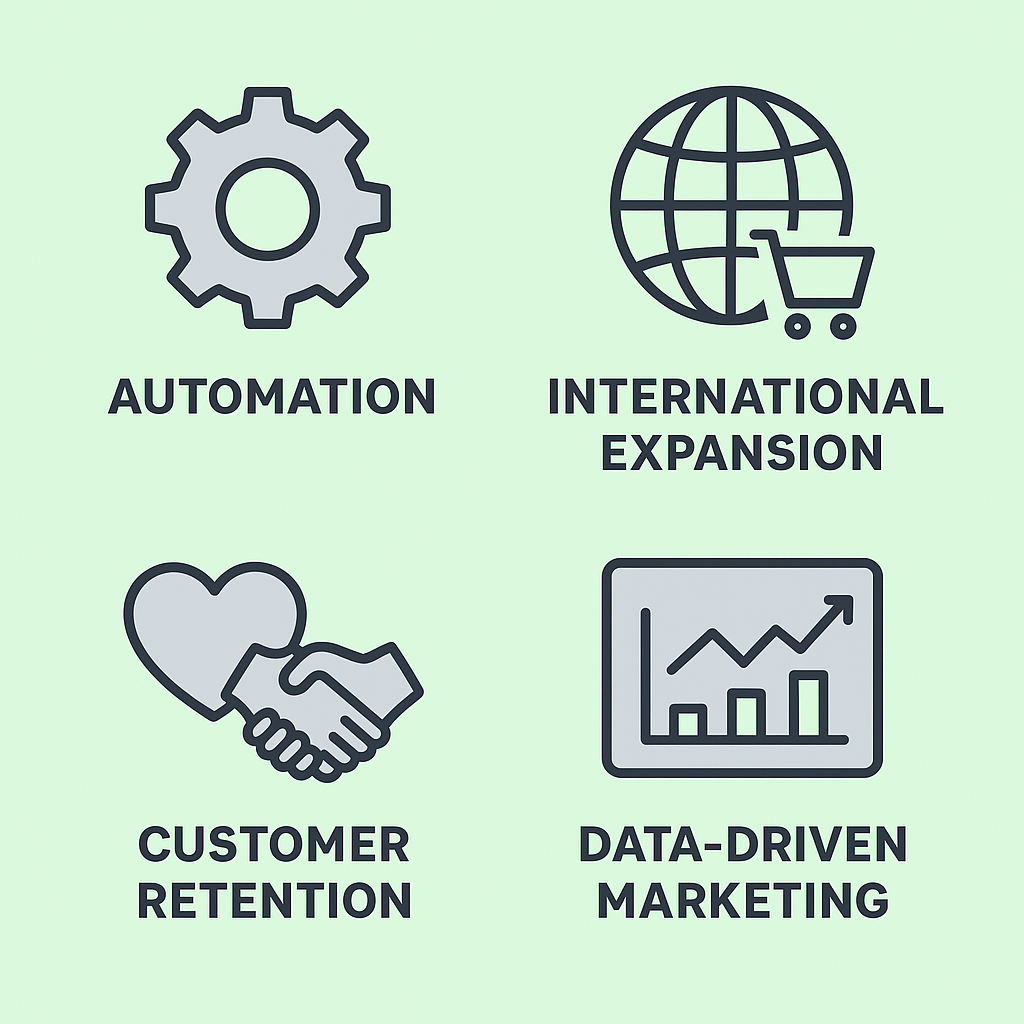
- Effective strategies for scaling an e-commerce business involve international expansion, partnerships, automation, data-driven marketing, and optimizing customer experience.
- Since the e-commerce business is a multifaceted industry, signs for scaling your business are solid cash flow, steady revenue, efficient operations, and repeat customers.
- Common problems for scaling in an e-commerce business lie in maintaining customers’ experience, supply chain issues, shortages in cash flow, and increasing ad costs.
- Successful brand stories occur when there is investment in technology, staying agile in the areas of your business, and focusing on customers as your business grows.

Enjoy seamless eCommerce integration with Hostonce
Experience lightening-fast speed and uptime with Ecommerce hosting. Protect your online store from threats with Hostonce’s secure hosting.
The Difference Between Growth and Scaling

1. Growing a Business
Growth takes place when you increase the revenue of your business by adding balanced resources such as bigger warehouses, more employees, or higher ad spend. For instance, if you hire extra workers and increase your Google Ad spend, you will have an increase in revenue. Keep in mind that your costs will also increase at the same pace to help maintain steady profit margins.
2. Scaling a Business
Scaling an eCommerce business in 2025 simply means boosting your revenue at a faster rate than costs. This occurs when you create automation, systems, and efficiencies that can help you accommodate more orders and customers without increasing your expenses sequentially. For example, using AI marketing campaigns or automating your order fulfillment can help you attend to more customers and manage high-traffic visitors without doubling your expenses.
| Aspect | Growth | Scaling |
| Definition | Boosting revenue by adding proportional resources | Increasing revenue without having a proportional increase in costs |
| Resources | More employees, bigger warehouses, higher ad spend | Automation, systems, and technology to handle more with less |
| Cost vs. Revenue | Costs rise at the same pace as revenue | Revenue grows faster than costs |
| Efficiency | Limited efficiency improvements | High efficiency through streamlined processes |
| Output Pattern | Linear (1:1 increase with resources) | Exponential (greater output with minimal extra input) |
| Example in E-commerce | Hiring more staff to handle order volume | Automating order fulfillment to process more orders without hiring |
| Sustainability | It can become expensive and hard to maintain | More sustainable and profitable long-term |
Scaling is the major distinction between online stores that are successful and the ones that stand still. Although growth can help build momentum, you will need scaling to make your business competitive, profitable, and sustainable in the long run.
Understanding Scaling in Ecommerce
Scaling an eCommerce business efficiently is about increasing customers, sales, and marketing reach without running into debt. Unlike simple growth that demands more resources, scaling concentrates on creating proven strategies and systems that can be used to handle more volume with fewer resources.
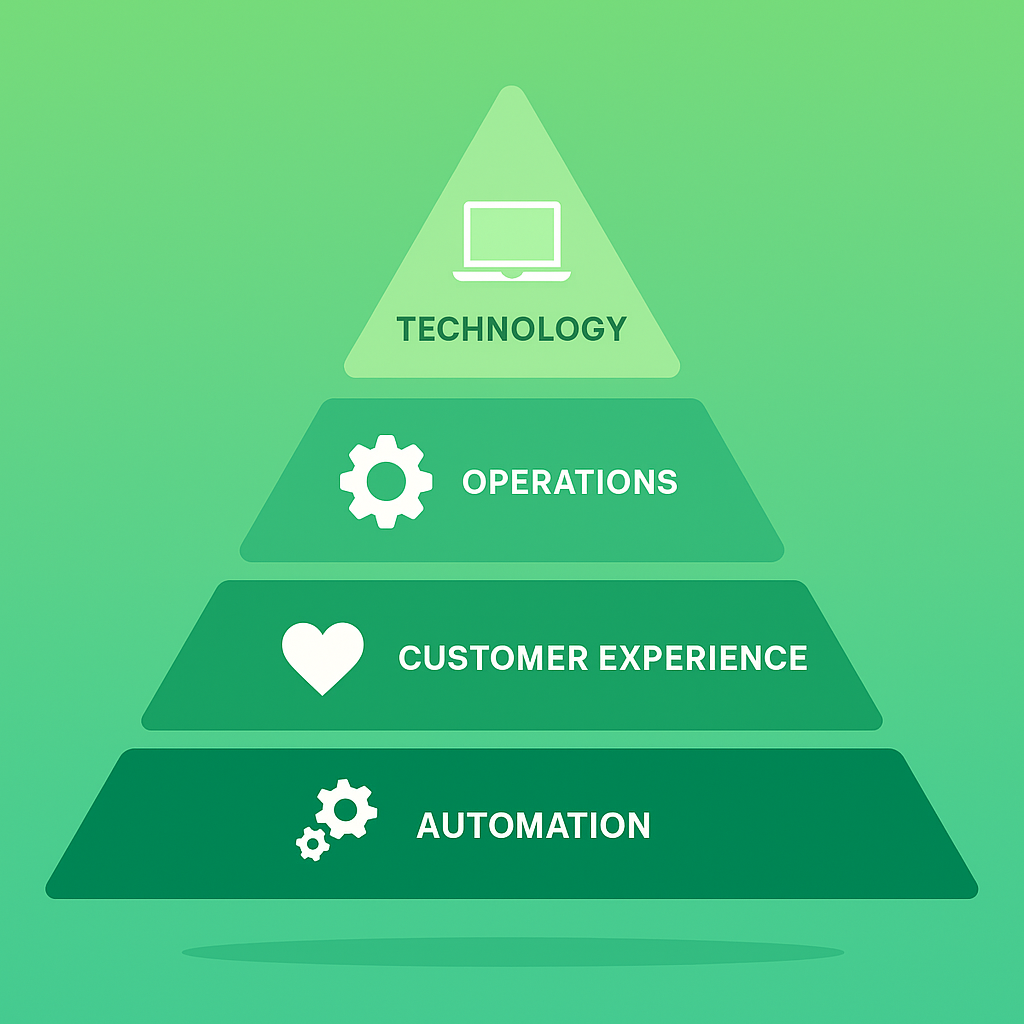
Core Foundations for Ecommerce Scalability
Scaling that is done on a strong foundation can lead to more eCommerce sales and a target audience without overspending. If you have unsuccessful strategies to help you with scaling, here are the core foundations to help you have eCommerce stability:
1. Robust E-commerce Platform: Ensure that your business runs a platform that is compatible with multi-channel selling, integrations, and automation. Popular platforms like Shopify and WooCommerce can help you scale to higher traffic and reach potential customers.
2. Efficient Supply Chain & Inventory Management: Every brand must have a supplier relationship that is credible to avoid congestion. Furthermore, you can apply inventory management tools to help you predict the demand of shoppers and prevent stockouts
3. Financial Stability & Cash Flow Management: Having a healthy cash flow is essential because it allows you to employ staff when necessary, invest in marketing, and implement strategies to scale your business. You can also look at financing options that will strengthen your scaling initiatives.
4. Operational Processes & Automation: Automating repetitive tasks like reporting and emails can help you optimize resources and free up time. You can also consider standard operating procedures (SOPs) to help your team smoothly handle growth.
5. Customer-Centric Approach: One of the best ways to scale efficiently is by investing in customer support systems. For example, you can have self-service help centers, chatbots, and live chat for customer feedback. This will help you understand your customers better and improve your services.
7. Scalable Marketing Infrastructure: If you are ready to scale, you will need to have a tracking tool. You can use Google Analytics or Meta Pixel for better results. Furthermore, consider building an email list to keep customers engaged as your business grows.
How to Scale an Ecommerce Business
It is easy to scale when you have a picture of what you want to achieve. With scaling, you can increase your marketing reach, boost revenue, and handle more orders. Here is a step-by-step guide on how to scale an e-commerce business successfully:
Step 1: Strengthen Your Foundation
Having a strong foundation is the first step to consider before looking to scale. You can build a solid foundation by having a stable cash flow, documenting processes, using a credible platform like WordPress, and streamlining operations. For instance, if you cannot keep up with orders or experience downtime during peak times, scaling will only increase these problems instead of tackling them.
Step 2: Optimize Your Website and User Experience
Your domain is the support system of your business. If a customer doesn’t purchase on your site, scaling traffic and ads will only lead to money wasted. It is advisable to concentrate on increasing speed, optimizing your product pages, making your site responsive, and streamlining checkout. The right message to the right people can lead to conversions.
Step 3: Leverage Automation and Technology
Manual processes are becoming ineffective when there is an increase in volume. eCommerce businesses scale efficiently with automation by using tools to automate different repetitive tasks like SMS campaigns, inventory management, and email marketing. Leveraging automation can create more time for you to concentrate on other areas.
Step 4: Expand Your Marketing Channels
Using one marketing channel for your business is risky. Scaling involves using different marketing channels like social commerce, paid ads, influencer partnerships, and SEO for success. With this move, you are not affected when one channel becomes a problem.
Step 5: Focus on Customer Retention
Studies show that getting new customers is 5x more expensive than keeping loyal ones. You can learn how to scale by concentrating on increasing customer lifetime value (CLV) via subscriptions, loyalty programs, and building wonderful post-purchase experiences.
6. Explore New Markets
After having a stable brand, you can explore new markets by selling on more marketplaces like Etsy or Amazon. You can also start new product lines with WooCommerce categories or enter international markets. The key is to be strategic and not be in a rush.
7. Monitor Data and Adjust
Scaling is an ongoing process that requires constant monitoring and adjustment. Successful brands monitor important metrics like average order value (AOV), CLV, conversion rates, and customer acquisition cost (CAC). With this information, you can cut costs, focus on working strategies, and try out new ideas.
Advanced Strategies for Scaling Your Ecommerce
Using advanced strategies can help unlock exponential growth for your business. Nevertheless, these strategies are only effective after building a strong foundation and growth strategies. The advanced strategies for scalable eCommerce include:
1. Implement Data-Driven Personalization
Personalization can greatly boost customer loyalty and conversion rates. Advanced scaling is more than just saying “Hi [First Name]” when you send messages or templates to offer personalized discounts, product recommendations, and shopping experiences based on how your customers behave.
2. Adopt a Subscription-Based Model
Subscriptions are one of the most effective methods for increasing customer lifetime value (CLV). By adopting subscription-based models like memberships or auto-replenishment, you can create predictable revenue and reduce churn. With Hostonce, you can get access to various subscription-based and membership WordPress plugins
3. Use AI and Machine Learning for Smarter Scaling
AI tools can do the heavy-lifting for you by predicting demand, improving marketing efficiency, optimizing pricing, and reducing cart abandonment. Using machine learning for scaling is one of the smart ways that can help you automate decisions and anticipate needs that usually demand manual input.
4. Explore International Expansion with Localization
Going global is an important step for scaling, and it goes beyond international shipping. Being successful starts from localization, which can be done by aligning your online store, currency, language, and marketing to fit regional markets.
5. Build a Strong Brand Community
Advanced scaling is about building a strong brand community that can lead to growth and engagement. A strong community can help promote loyalty, user-generated content, and word-of-mouth marketing that reduces acquisition expenses. For example, Glossier became scalable by changing its customer base to a strong community via IG engagement, customer feedback loops, and creating superfans.
6. Strategic Partnerships and Collaborations
No business can succeed alone. Collaborating with relevant influencers, brands, or platforms can increase scaling for your business. Strategic partnerships help to expose your products to new customers, and using cross-promotions can increase your traffic without spending much.
Signs Your Ecommerce Business is Ready for Growth
After understanding how scaling works and the strategies that can help you scale, it is vital to know the right time for growth. So we have accumulated the possible signs to look for:
1. Consistent Sales and Revenue
If your online store is constantly bringing in revenue and sales every month, it is a strong sign that you have discovered your product-market fit. Having this consistency means that there is always demand and you’re not depending on one-time campaigns or luck.
2. High Customer Retention and Repeat Purchases
If customers keep returning to your eCommerce store, it shows that your product resonates. Having customer retention lowers the chances of depending on costly acquisition campaigns and can make scaling sustainable for you.
3. Strong Operational Efficiency
The smooth running of operations like shipping, customer service, and inventory is a sign that you can scale effectively. Strong operational efficiency is all about having systems that work under higher volume, fulfilling orders on time, and handling customer queries.
4. Positive Cash Flow and Healthy Margins
Scaling is not feasible without money. A solid profit margin and positive cash flow will allow you to hire new employees, make an investment in marketing like TikTok, and buy better tools without going bankrupt.
5. Growing Brand Awareness
If people are constantly recommending your brand without any effort from you, it is a strong sign for scaling. User-generated content, organic reach, and word-of-mouth marketing indicate the potential of scaling effectively. Positive feedback and referrals can lead to brand awareness.

Leveraging Marketing Strategies for Growing Your Business
Marketing is the driving force for eCommerce growth. To become successful in scaling, you’ll need to have a website and leverage various marketing strategies that can reach your targeted audience at the right time. Below are powerful marketing strategies for growing your business:
1. Use Paid Advertising for Immediate Reach
Paid ads are very effective for driving sales and traffic to an eCommerce platform. Using platforms such as Instagram, Google Ads, TikTok, and Facebook can help you target your audience with the right precision. Ensure that you start small, scale budgets, and test different creatives after seeing steady returns.
2. Content Marketing and SEO for Long-Term Growth
Although paid ads are the fastest way to gain traffic, they are expensive. Leveraging SEO and content marketing is important for gaining long-term growth. You can create tutorials, publish blogs, and product-focused content that can attract traffic to your site.
3. Email and SMS Marketing for Customer Retention
After you have obtained customers, keeping them engaged is one way to build customer loyalty. Using SMS and email marketing can help drive repeat purchases and create a fan base. Furthermore, a customer can make a purchase when there is an exclusive offer or personalized product recommendations.
4. Influencer and Affiliate Marketing for Trust and Reach
Influencer marketing can increase the trust and reach of your brand. Partnering with micro influencers can help produce higher engagement than celebrities because of their authenticity and niche appeal.
Expert Tip
It’s cheaper to keep a customer than to acquire a new one. Focus on retention strategies like personalized marketing, loyalty programs, and excellent post-purchase support. Scaling successfully means improving continously based on customer insights

Common Challenges in Ecommerce Scaling
- As there is an increase in demand, managing inventory can become more difficult. Inventory and supply chain issues can stall growth
- Higher scaling leads to more spending because you are trying to get new customers. The cost of running paid ads will keep increasing, making it hard to have steady profits.
- Maintaining customer experience can be difficult for a large customer base. Poor experiences for companies having more than 10,000 customers can harm brand credibility.
- Scaling to drive traffic demands an upfront investment in different areas. Managing budgets can be a problem if the business faces cash shortages.
- As an eCommerce hosting brand scales, there is bound to be an operational complexity, like larger teams, different sales channels, and international markets. These complexities can lead to inefficiency.
Final Thoughts
Scaling an ecommerce business involves building an effective system that can handle higher demand without affecting customer satisfaction or quality. From knowing the differences between growth and scaling to implementing the best strategies, you can build a scalable business in your niche. Although there are challenges that may arise, the success of an eCommerce business lies in preparation and thriving in a competitive market. The e-commerce business is a multifaceted industry, and staying updated with our latest trends on Twitter (X) is very important.
FAQs
How do I know if my business is ready for ecommerce scaling?
Signs your business is ready include consistent revenue growth, repeat customers, efficient operations, and strong cash flow. If your store struggles with order fulfillment or customer service at current levels, focus on fixing these before scaling.
What are the best strategies for ecommerce scaling?
Some of the most effective strategies include investing in automation, expanding internationally, improving customer retention, leveraging data-driven marketing, and outsourcing logistics through 3PLs.
What challenges do businesses face when scaling ecommerce?
Common challenges include supply chain disruptions, rising customer acquisition costs, cash flow shortages, and maintaining customer experience as order volumes increase.
How long does it take to scale an ecommerce business?
There’s no fixed timeline; it depends on your resources, strategies, and market conditions. Some businesses scale in months, while others take years to achieve sustainable growth.

How to Integrate Google Analytics with WordPress (In 4 Steps)
By Favour Brown on September 6, 2025
Hostonce is the #1 WordPress Host
Ranked by 930+ customers in G2's Best Software Awards.
