



With a predicted compound annual growth rate (CAGR) of 13.9%, the market for digital marketing growth is expected to reach $786 billion by 2026, according to industry estimates.
It doesn’t seem like the industry’s growth is slowing down. The growth statistics for digital marketing demonstrate how much firms today rely on online marketing trends to reach consumers.

12 AI Tools for Marketing: Improve SEO, Personalization, and Automation for Your Business
By Favour Brown on June 3, 2026Key Takeaways
- By 2026, content marketing is going to be a real powerhouse, with growth of almost 50% – that should firmly cement its place as a top traffic and lead generator in the long term.
- By 2026, the MarTech market is set to balloon up to about $669 billion, largely thanks to the increasing use of AI and automation.
- In 2026, we’re going to see short-form video ad spending hit $122.5 billion, and that’s going to make it the quickest-growing ad format out there.
- Total digital video ad spend is looking like it’s going to blow past $223 billion in 2026, which will all but confirm that video is now the dominant ad channel.
- By 2026, we’re expecting around 73% of marketers to be actively using AI marketing tools to help with automation and personalization—that’s going to be a major shift.
- By 2026, AI is going to make a huge difference to content creation, with production times potentially reducing by as much as 40%—that should give marketers a real boost in terms of campaign speed and scalability.
Table of Contents
- Digital Marketing Growth Rate Statistics
- Digital Advertising Growth In Digital Marketing
- Marketing Technology (MarTech) Statistics
- SEO & Content Marketing Growth of Digital Marketing
- Social Media Marketing In The Digital Marketing Industry
- Video Marketing Statistics
- Email Marketing Statistics
- Conclusion
- FAQs
Digital Marketing Growth Rate Statistics
Here are digital marketing growth rate stats you should consider:
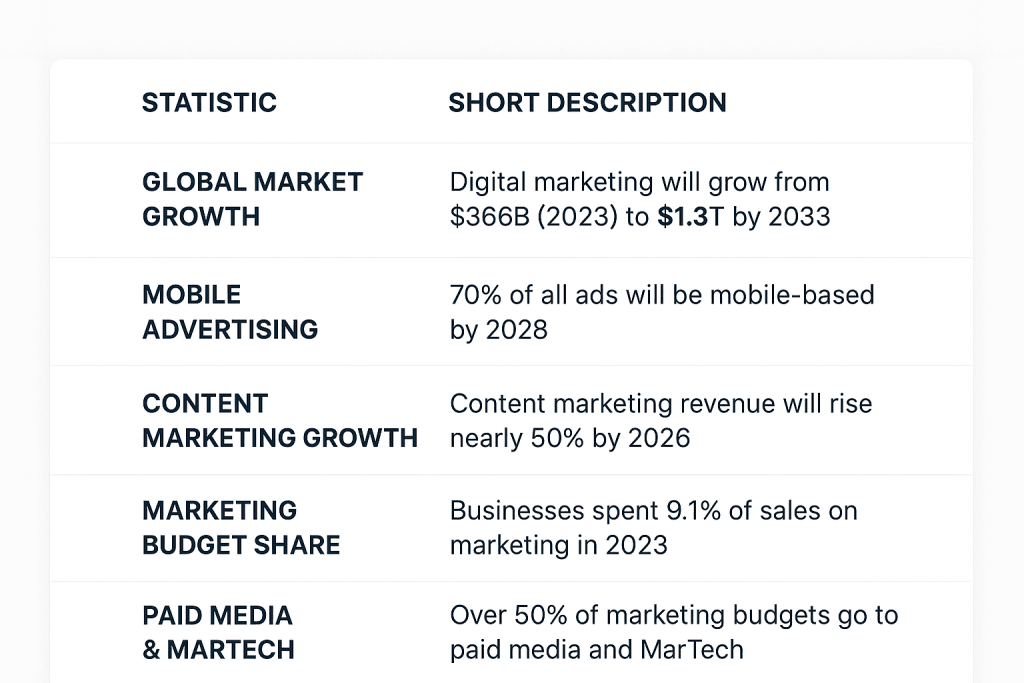
- 1. The global market for digital marketing might grow from $366 billion in 2023 to an astounding $1.3 trillion by 2033. The ease and effectiveness that digital marketing provides to both consumers and organizations is the driving force behind this astounding expansion.
- 2. By 2028, mobile advertising is expected to make up 70% of all advertising expenditures. Businesses are prioritizing mobile-friendly advertising techniques, which is not surprising given that the majority of internet users receive material via mobile devices.
- 3. One of the main components of digital marketing strategies is still content marketing. With an anticipated nearly 50% rise in industry revenue between 2022 and 2026, content marketing continues to be an affordable means for companies to attract traffic to their online stores, provide leads, and foster brand loyalty.
- 4. Video marketing is another area enjoying considerable growth. The video advertising market reached a valuation of approximately $191 billion by the end of 2024. The video advertising industry is expected to grow at a 23.63% CAGR from its estimated USD 82.68 billion in 2025 to USD 163.95 billion by 2030. As consumers enjoy on-demand viewing, advertisers are shifting their money from linear television to streaming and mobile platforms.
- 5. Businesses are devoting a large percentage of their marketing spending to digital channels in response to the growing significance of digital marketing. Businesses in North America and Europe spent 9.1% of their total sales on marketing in 2023, with paid media and marketing technology accounting for more than half of these expenditures.

Claim Your Digital Domain Now!
Secure a unique online identity that reflects your business idea. Register your websites in seconds with HostOnce to be a part of the digital marketing industry!
Digital Advertising Growth In Digital Marketing
You should also consider these advertising digital marketing growth statistics:
- 6. To begin with, it was anticipated that U.S. digital ad spending would increase by 7.5% in 2025, reaching an all-time high of $315 billion, and might increase further in 2026.
- 7. Google dominates 91.88% of the global search engine market, so the finest option for online advertising is Google’s PPC.
- 8. Brand awareness can increase by 80% with advertisements. Brand awareness can rise by 80% when PPC advertisements are included in your campaign.
- 9. Instagram ads can reach a staggering 928.5 million individuals, as Hootsuite has reported. Instagram’s ad metrics are pretty mind-blowing – ads can hit about 928.5 million out of the billion active Instagram users.
- 10. According to the numbers, native ads are a heck of a lot easier to get your head round – a full 31 per cent simpler than social media ads and 62 per cent simpler than display ads.
- 11. In terms of content recommendations, typically you’re using eye-catching headlines and graphics that grab the reader’s attention and make them want to click through. It’s been proven that this native advertising tactic can drive up to 53 per cent more page views than a search engine click.
- 12. Every month, YouTube ads reach 2.53 billion people, which is a lot more than the 2.22 billion Facebook users that Meta says it has.
- 13. According to a study from 2023, 98 per cent of those who do pay-per-click marketing said they used Google search ads, and 67 per cent of respondents also mentioned Bing – Google’s main competitor.
- 14. The lowest cost-per-click in search marketing is in real estate and arts and entertainment, sitting at an average of $1.55.
- 15. PPC advertising typically costs anywhere from $0.11 to $0.50 a click and from $0.51 to $1 a thousand impressions on platforms like Google Ads or Microsoft Ads.
Expert Tip
It can be overwhelming to advertise. Even seasoned marketers use antiquated promotional techniques. Understanding the proper advertising techniques will help you spread the word about your company in light of the internet’s ever-changing algorithms. Compared to visits from organic links, PPC traffic has a 50% higher conversion rate. Also, after seeing display ads, consumers are 155% more likely to search for phrases unique to your business.

Marketing Technology (MarTech) Statistics
The biggest change in digital marketing growth is the incorporation of artificial intelligence. It provides deep predictive insights, automates repetitive processes, and even collaborates on creative projects. Adopting AI will provide businesses with a big competitive edge.
- 16. The market for marketing technology (MarTech) might be worth USD 557.94 billion in 2025 and also might grow at a compound annual growth rate (CAGR) of 19.93% from 2025 to 2034, from USD 669.14 billion in 2026 to roughly USD 2,863.76 billion.
- 17. Scaling their marketing campaigns has been the biggest influence of AI, according to 58% of marketers. AI can handle email drip campaigns, A/B test landing pages, and automate and optimize paid ad campaigns at a scale that no human team can match.
- 18. 73% of marketers are already using AI tools in marketing. The most common use of AI in marketing is generative AI for content generation. Your rivals are using AI to produce graphics, make blog posts/drafts, and craft ad copy. If not, you are already lagging in productivity and efficiency.
- 19. Writing a piece of long-form content can be completed in 30–40% less time with AI-powered content production.
- 20. According to 64% of companies, AI will enable them to offer a more customized client experience. Using a customer’s first name alone is no longer sufficient for personalization. In order to provide really personalized content, product recommendations, and offers, AI can instantly assess browser history, purchase data, and demographic information.
SEO & Content Marketing Growth of Digital Marketing
The best long-term digital marketing growth techniques include content marketing and search engine optimization (SEO). A high-ranking post can generate free, quality traffic for years, whereas bought advertisements end when your budget does. In 2026, the approach will be less about “tricks” and more about exhibiting true authority and competence.
- 21. A search engine like Google, Bing, etc., is the first step in 68% of all online interactions. The most common way for individuals to find goods, services, and information is through search. The great bulk of your target market will not be able to see you if you are not visible on Google.
- 22. The click-through rate for “long-tail” keyword searches (three or more words) is three to five per cent greater than that of generic searches. One-word, vague keywords like “marketing” have little buying intent and are very competitive. “Digital marketing statistics for 2025” is an example of a long-tail term that is precise, less competitive, and draws in a highly qualified audience.
- 23. Updating and republishing previous blog post entries with fresh images and material can boost organic traffic by up to 106%. You have a treasure trove of old content. Keep it from rotting. Refreshing it offers a huge SEO reward and requires significantly less work than creating a new post from the beginning.
- 24. SEO workflows are evolving as generative AI is used more frequently. For instance, while two-thirds of companies use AI for outlines, drafts, and brainstorming sessions, 25% are concerned about how AI may affect website traffic.
- 25. In the past two years, “near me” and “local” searches have increased by more than 200%. Local SEO is your most crucial channel if you are a local or service-area business.
How Much Do Companies Spend On SEO?
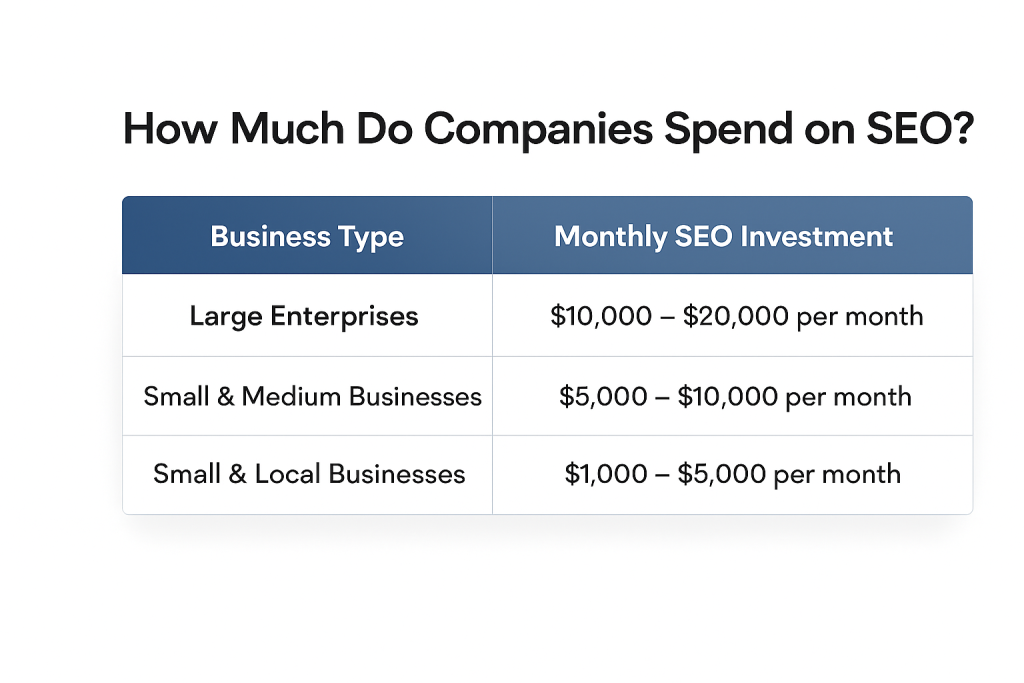
- 26. Depending on where they are in their plan, large organizations may spend between $10,000 and $20,000 a month on SEO.
- 27. SEO costs for small and medium-sized businesses can range from $5,000 to $10,000 per month.
- 28. SEO costs small and local businesses between $1,000 and $5,000 a month.
Here are digital marketing growth statistics related to social media marketing:
- 29. In 2025, social media was more about connecting than broadcasting. It is a “community hub” where companies may interact directly with their most devoted followers and a “discovery engine” powered by short-form video.
- 30. Of all the social media marketing formats, short-form video, such as TikTok videos and Reels, offers the highest return on investment. The algorithms strongly favor this format, and people have short attention spans. It is the best method for reaching a large, new audience.
- 31. 79% of respondents can’t help but be swayed by the influence of user-generated content, which makes sense when you think about it. It’s a big deal because its effect is even stronger than that of a review. What really carries weight is seeing some regular bloke using and enjoying your product – not some influencer.
- 32. At the end of 2024, the influencer marketing, like Instagram influencer marketing, TikTok influencer marketing, etc, scene was worth a whopping $24 billion. Mainly because it means influencer marketing is no longer some wild and woolly experiment – it’s become a tried and tested channel.“Micro-influencers” (we’re talking 5,000 to 20,000 followers here) have a highly engaged crowd that is genuinely interested in the niche they follow – which can offer a real return on investment.
Market Your Business Online!
Give your business the digital presence it deserves with optimized and premium hosting solutions by HostOnce.
Video Marketing Statistics
Here are digital marketing growth statistics about video marketing you should know:
- 33. With video streaming expected to make up 91% of all internet traffic worldwide, video marketing has quickly emerged as a crucial element of effective marketing tactics.
- 34. Global spending on digital video advertising surpassed $190 billion in 2024 ($191.4 billion), according to Statista’s most recent video marketing data.
- 35. For the remainder of the decade, industry spending might rise, but more slowly. Spending might rise by 7.7% in 2026, beyond $220 billion ($223.5 billion) to $239.1 billion (+7%).
- 36. Global spending on digital video advertising might reach $268 billion by 2029, an increase of more than 29% from 2025.
- 37. According to Statista, short-form digital video advertising is expected to cost $111 billion globally in 2025. If accurate, the industry’s spending will rise by around 12% starting in 2024 ($99.43 billion).
- 38. After 2025, spending might increase more slowly, hitting $122.5 billion in 2026 (+10.2%) before surpassing $134 billion a year later (+9.6%).
- 39. Industry spending will be almost 100 times more in 2029 than it was in 2017 if predictions come to pass, driven by the rapid rise of platforms like YouTube Ads and TikTok Ads.
- 40. The total amount spent on digital video ads might climb by around 12% from 2025 to $38.45 per internet user by 2029.
- 41. More than half (55%) of companies make their own digital marketing videos, according to recent video marketing statistics.
- 42. Roughly three-quarters (73%) of organizations utilize explainer videos in their marketing approach.
- 43. Social media videos are produced by more than two-thirds (69%) of firms, e.g., e-commerce businesses, which is 9% higher than any other kind.
Email Marketing Statistics
Out of all digital channels, email marketing consistently yields the highest return on investment. In a world without third-party cookies, the importance of your direct, private channel of contact with your audience is growing. Reliability, automation, and deep customisation are the main priorities.
- 44. For every $1 invested, email marketing yields an average return on investment of $36. This return is unmatched and validated. There isn’t a single other channel that compares. The safest option in digital marketing is to invest in expanding and maintaining your email list using tools like Mailchimp or Klaviyo.
- 45. 78% of marketers reported an increase in email interaction. People are going back to email as social media gets noisier and advertisements are more costly. They view it as a more straightforward, regulated, and polished method of communicating with companies they can trust, using services like Constant Contact or Campaign Monitor.
- 46. Revenue is increased by 760% because of segmented email campaigns. It is inefficient and lazy to send out the identical “newsletter blast” to everyone. Consumers anticipate material that speaks to them, and using email list-building strategies helps improve personalization at scale.
- 47. Giving customers flexibility over when and how they get emails makes them feel more connected to a company, according to 55% of consumers. Keep your list intact. Users will designate you as spam if they can’t simply manage their settings or unsubscribe, which negatively impacts your deliverability for everyone.
Strengthen Your Email Marketing ROI!
Power your email campaigns with secure and high-deliverability email hosting built for growing businesses.
Conclusion
The future is clearly depicted by these 47 digital marketing growth stats. The 2026 marketer is an “integrator,” combining elements of a content strategist, AI operator, data scientist, and UX designer.
Mastering a single channel is no longer the key to success. It involves creating a cohesive, integrated system in which each component functions as a whole. It is evident from the data that companies that invest in a comprehensive, end-to-end digital platform will succeed.
FAQs
What is the 40-40-20 rule in mail marketing?
The three fundamental components of direct mail marketing can be viewed using the "40/40/20" method. Finding the correct target accounts for 40% of direct marketing success, the offer itself accounts for 40%, and timing, structure, and overall design factors account for 20%.
What is the 70 20 10 rule in digital marketing?
In content marketing, the 70 20 10 rule is a tactic that directs how to balance various kinds of content for your company. It's a structure that marketers use to ensure that the content and timing of their posts on behalf of a business are deliberate. It all comes down to structure.
Is AI replacing digital marketing?
AI won't entirely replace marketers, but it will alter how they operate. Effective marketing still need human creativity, strategy, and connection, even while AI can do repetitive jobs.
What are 7 types of digital marketing?
- Search engine optimization (SEO).
- Content marketing.
- Affiliate marketing.
- Pay-per-click (PPC).
- Influencer marketing.
- Social media marketing.
- Email marketing.

Bulk SMS Marketing Strategies
By Festus Nkopuruk on June 2, 2026
Hostonce is the #1 WordPress Host
Ranked by 930+ customers in G2's Best Software Awards.