





Blogging has managed to remain a powerful tool for both businesses and individuals. Choosing the right blogging website is an important decision that can be overwhelming, as there are nearly countless options (free and paid). This article serves a comprehensive guide, highlighting the key factors necessary to make your choice.
The platform hosting your blog serves as the foundation of your digital presence, impacting every single thing you do on the blog: site design and functionality, search engine visibility, and future monetization. Making the wrong decision is frustrating. It limits growth, and causes financial losses somewhere down the line.

Blog Name Ideas: Finding the Perfect Name for Your Blog
By Festus Nkopuruk on July 7, 2025Factors to Consider to Choose the Best Blogging Website
Optimally, a few factors should guide you on how to choose the best blogging platform, and your eventual decision should be aligned. It is important to identify these essential factors.

Are You Ready to Launch your Blogging Website?
Start your blog with reliable hosting and reach the right audience. Sign up today. Hostonce’s wide range of plans suit specific needs, if you are just starting or looking to scale your existing blog.
1) Ease of Use and Learning Curve
Are you familiar with web interfaces? Some platforms offer almost limitless flexibility at the cost of a high learning curve (coding).
While some blog hosting sites are designed to be simple to use, targeting beginners by implementing drag and drop interfaces, requiring no coding.
The question you should be asking is how much time you are willing to sink into learning how to use whatever platform you choose.

2) Customization Options
Blog owners often know how they want their blogs to look, but the amount of needed control over appearance and function varies between individuals.
Do you think you need extensive theme options, support for plugins, and the option to fiddle with code? Or are you going to be satisfied with good cookie-cutter templates?
It is not an exaggeration to say that the degree of customization you choose is going to affect your brand identity and user experience.
3) SEO Friendliness
SEO is largely responsible for getting discovered by ranking on search engines. Is there a point to producing quality content if nobody gets to see it?
4) Hosting and Scalability
Self-hosting or Managed platforms? WordPress.org is a self-hosting platform and it means you have to pay for your blog’s hosting yourself.
Squarespace and WordPress.com are examples of managed platforms, they do the technical stuff.
So, you have to consider your projected growth and traffic: will the platform you choose be able to scale without issues as your site grows?
5) Monetization Options
How are you going to make money from your blog (if you are going to)? If a platform doesn’t support it then obviously that platform isn’t a fit. Popular monetization methods include advertising, affiliate marketing, and offering subscription plans.
Learn about monetization strategies in our domain and email hosting guide.
6) Support and Community
Knowing where to get help is lifesaving (and it also saves time). It might be dedicated customer support, or an active community of users, or a platform knowledge base.
7) Cost
Cost perhaps is the most important factor above all else, as financial constraints cannot be ignored.
Free-to-use blog hosting sites are very limited and paid plans offer basically everything.
Other financial factors (apart from platform fees) include hosting and domain name, themes, and plugins.
Best Blogging Websites in 2026 (Free & Paid)

We are going to analyze a number of the best blog hosting sites in 2026. A breakdown of their strengths and weaknesses should give you a comprehensive understanding that allows you to decide where to host a blog effectively.
Free Blog Hosting Sites
Free options appeal greatly to individuals who are trying their hands at blogging without committing their finances to it. Hobbyists also like free options. The connecting thread is that both parties are aware that there are many limitations.
Blogger (by Google)
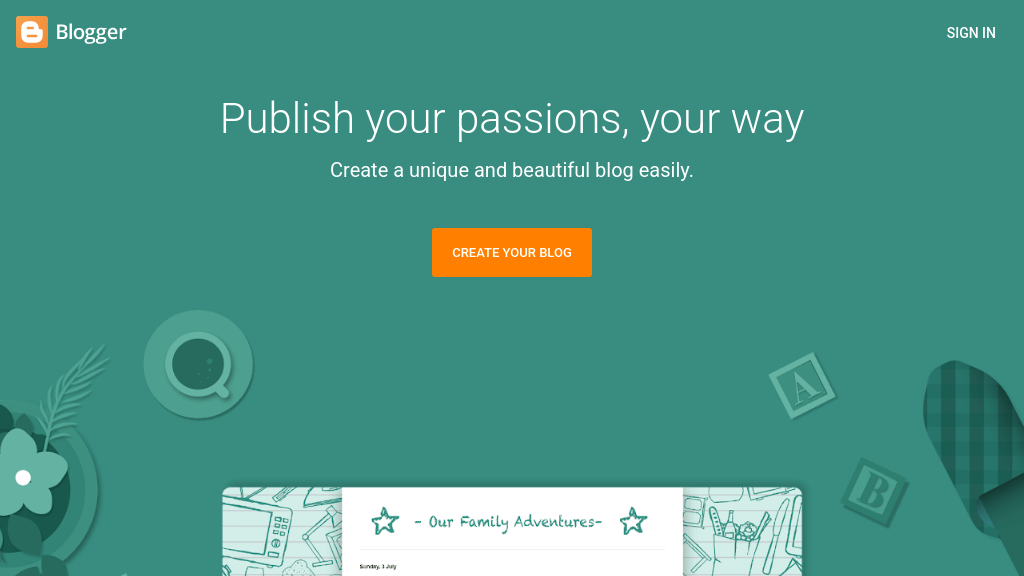
| Key Features | Description |
| 🖱️ Interface | Beginner friendly as well as clean and intuitive |
| 💰 Monetization | Google Adsense allows for monetization |
| 🌐 Hosting | Hosting by Google is very reliable |
| 📊 Analytics | Uses Google Analytics and other ecosystem services. |
Pros
- Blogger is quite easy to learn to use
- It can be integrated with Google AdSense and Analytics.
- It has a free option for a custom domain, i.e., blogname.blogspot.com.
- And the hosting is very reliable.
Cons
- Blogger’s templates are outdated
- Few features when it is compared to other free options.
- And Google has significant control over the contents of your blog posts.
Best for
Hobbyists and personal journals
WordPress.com

| Key Features | Description |
| 🖱️ Interface | Requires no coding and uses a dashboard streamlined for beginner |
| 💰 Monetization | Limitations on the free plan are unlocked with higher tiers of subscription |
| 🌐 Hosting | Managed by WordPres.com. It is secure and well maintained |
| 📊 Analytics | Inbuilt analytic tools are available and advanced tools can be integrated |
Pros
- They have a very friendly user interface
- A bunch of free themes,
- And there are no hosting problems.
Cons
- You won’t be able to get rid of their ads, sort of like a nasty watermark.
- Limited customization on your blog’s appearance and theme.
- Very limited plugins and monetization channels.
Best For
Hobbyists & Beginners.
Medium

| Key Features | Description |
| 🖱️ Interface | Minimalist and distraction free, focusing on the reading and writing of content, rather than technicalities |
| 💰 Monetization | Partner program lets writers earn money based on the engagement their blog receives |
| 🌐 Hosting | No hosting, setup, or registration is required |
| 📊 Analytics | Engagement metrics (views, reads, and reading time) |
Pros
- A good fit for writers as it has a large reader user base
- Monetizable through their Partner Program
- It comes with a writing environment that has been stripped of distractions.
Cons
- All content is published on their domain making it near impossible to build an independent readership
- The audience belongs to Medium and you’re just hitching along for a ride.
Best for
Writer content creators
Paid Blog Hosting Sites
These are the best options for the most possible control, maximum scalability and potential for monetization. Paid blogging sites (self-hosting) need a financial commitment from the owner and they return true ownership and versatility.
WordPress.org

| Key Feature | Description |
| 🖱️ Interface | More complex but powerful and affords superior flexibility for content management. |
| 💰 Monetization | Revenue can be obtained from any source due to complete ownership and content control |
| 🌐 Hosting | A web host is required, unlike WordPress.com |
| 📊 Analytics | Nothing is inbuilt but any thirdparty tool can be integrated |
Pros
- Among the benefits of WordPress, the most notable one of the library of plugins.
- It is also very scalable no matter how large your business gets (they host NASA and the NY times).
- Massive community with technical resources to help as it is an open source platform and hosts approximately 40% of all the websites around today.
Cons
- Costly as you pay extra for your hosting provider and your domain name.
- You are also responsible for the day-to-day maintenance of your site and that includes keeping it up to date and implementation of security protocols.
- It’s harder to use than drag-drop web builders.
Pricing
You don’t pay for the software itself, not directly, but premium themes cost money and so do the premium plugins.

If WordPress.org sounds perfect to you and you need to know where to host a blog you should pay attention to the following:
- Hostonce: The high mark is WordPress hosting service and their responsive hosting support is a great lifeline.
- Ultahost: User-friendly and affordable with consistently good performance that is hard to find a fault in.
- Bluehost: The most recommended hosting provider as it is officially endorsed by WordPress and is easy to install.
- DreamHost: Here is another hosting provider with the official WordPress stamp with a great reputation and similarly good features with other endorsed ones.
Explore shared hosting at Hostonce if you’re just starting out
Squarespace

| Key Feature | Description |
| 🖱️ Interface | Beginner friendly, drag-and-drop, and requires no coding knowledge |
| 💰 Monetization | Inbuilt eCommerce tools are available |
| 🌐 Hosting | No need to look for web hosting, Squarespace handles everything |
| 📊 Analytics | Analytics dashboards are available, though not advanced, it is robust. |
Pros
- Many people regard Squarespace templates to be very professional looking and aesthetic. And they are.
- Its drag and drop interface is easy to use and natural to use.
- Visually-oriented blogs opt to use Squarespace for its aesthetics.
- Furthermore, it has built-in hosting.
Cons
- However, there aren’t as many plugins as on WordPress.
- It is also lacking in deep customization options.
- It is a tad expensive if needs are basic.
Pricing
Annual billing that comes around to $16 every month for their personal plans and higher tiers exist.
Substack

| Key Feature | Description |
| 🖱️ Interface | Distraction free, perfect for writers of all categories. |
| 💰 Monetization | Built-in monetization lets writers charge members for subscriptions |
| 🌐 Hosting | Substack manages everything on their ecosystem |
| 📊 Analytics | Metrics (open rates, engagement levels, and revenue tracking) but cannot compare to advanced analytics. |
Pros
- Newsletters—that’s the appeal
- Paid subscriptions as the means of in-built monetization methods.
- Setup is designed for beginners (usually writers of every kind)
- And they also have in-built tools to engage an audience with.
Cons
- Limited design, limited customization.
- Blogging is second place as the focus is on email newsletters
- And of course the platform takes a cut.
Pricing
Free. 10% commission on every subscription.
Best for
Writers and journalists.
Making Your Final Decision
We have gone over what to ask yourself to choose the best blogging platform. Just in case you need a reminder here are they again, summarily:
- What is your primary goal?
- What is your budget?
- How good are you with new technology?
- Do you think design and customization are important?
- How fast do you plan to grow your blogging website?
Conclusion
Therefore, when you want to pick what we call the best blogging platform in the post-lockdown economy you shouldn’t expect to find an answer that checks all your boxes. WordPress.org runs nearly half of the sites on the internet and it is usually the top recommendation when paired with reliable hosting providers.
Depending on what your priorities are you can choose there are a wide range of other options ranging from Squarespace to Substack to completely free options (if that’s what fits your needs). Regardless, you must be able to look at your personal needs and goals and if you are technically-savvy before you can choose a blogging website to empower and not kill your blogging aspirations.
ChatGPT for SEO: How AI is Changing Content Optimization & Rankings in 2026
By Hamza Aitizad on August 9, 2025FAQs
I have been using WordPress.com for as long as I can remember but it seems no one is using this platform anymore. I don't want to learn coding but I have heard good things about WordPress.org. Any advice?
Wordpress dot org is the best. Good news; the site is already coded for you. No need to learn or practice coding. Wordpress.org is the biggest platform out there and you don’t need to have coding knowledge to use it.
Where is the best place for web developers to have a blog?
You can try Medium and Substack.
Is there any value in using Blogger?
Blogger is great for a hobby.
Which blogging site is the fastest for quick monetization? I am a student I don't have money!
WordPress.com and Blogger are good free options for beginners. And look ... if you get traffic you can monetize!

Hostonce is the #1 WordPress Host
Ranked by 930+ customers in G2's Best Software Awards.

