
Email marketing is the best high-return channel in 2025. Email marketing gets a 36-42x ROI in comparison to other marketing channels. Even amidst the economic downturn, over 4.3 billion people in the world use email. Small and medium enterprises (SMEs) use email marketing extensively. Moreover, automated emails get 6x more conversions than non-automated emails. With a decrease in attention spans and an increase in competition in the email marketing software space, the choice of an email marketing platform affects a company’s income and growth.
This guide focuses on the 15 best Email marketing platforms, outlining features, costs, and strategies to help you finally get to the email marketing tool that meets your business needs.
Discover the 5 Best Cheap Email Hosting Providers in 2026
By Festus Nkopuruk on April 1, 2026Key Takeaways
- Email marketing is the best channel for the highest marketing ROI.
- There’s no best email marketing platform. Each platform is the best, based on your business, your goals, and your audience.
- For beginners and small enterprises, it’s prudent to choose affordable, simple platforms, particularly those offering free plans.
- For bloggers and content creators, automation and ease-of-use features are important for audience engagement.
- For eCommerce stores, the best platforms must have revenue-driven analytics, automation, and systems that smoothly communicate with other apps.
- Businesses and agencies look for adaptable systems with effective CRM integration and reporting.
- Starting with a small scale and progressively increasing your services as your requirements expand is a wise and cost-saving strategy.
Table of Contents
- What are Email Marketing Platforms?
- 15 Best Email Marketing Platforms
- 1. Mailchimp
- 2. Constant Contact
- 3. Brevo (formerly Sendinblue)
- 4. HubSpot Email Marketing
- 5. ActiveCampaign
- 6. ConvertKit
- 7. AWeber
- 8. GetResponse
- 9. Klaviyo
- 10. Campaign Monitor
- 11. Drip
- 12. Moosend
- 13. MailerLite
- 14. SendGrid
- 15. Zoho Campaigns
- Comparison Table: Best Email Marketing Platforms at a Glance
- How to Choose the Right Email Marketing Platform
- Email Marketing Platforms vs Email Sending Tools
- Final Thoughts
- FAQ
What are Email Marketing Platforms?
Email marketing platforms are a type of software that enable organizations to design, distribute, supervise, and analyze email campaigns to connect with their customers. Instead of manually emailing clients, these programs let you automate the process so you can manage your emails and campaigns from a single dashboard while creating emails and branding professionally.
Email marketing automation, triggered emails, segmentation, and performance analytics are also provided by these tools. Businesses are able to use these tools to scale their efforts—lead nurturing, product promotion, cart recovery, newsletter distribution, and relationship building—while the tools also ensure regulatory compliance.
15 Best Email Marketing Platforms
The email marketing domain you choose will determine how successfully you will reach, engage, and convert your audience. Below is a collection of the best email marketing tools available today, sorted by ease of use, features, and recommended use case.
1. Mailchimp
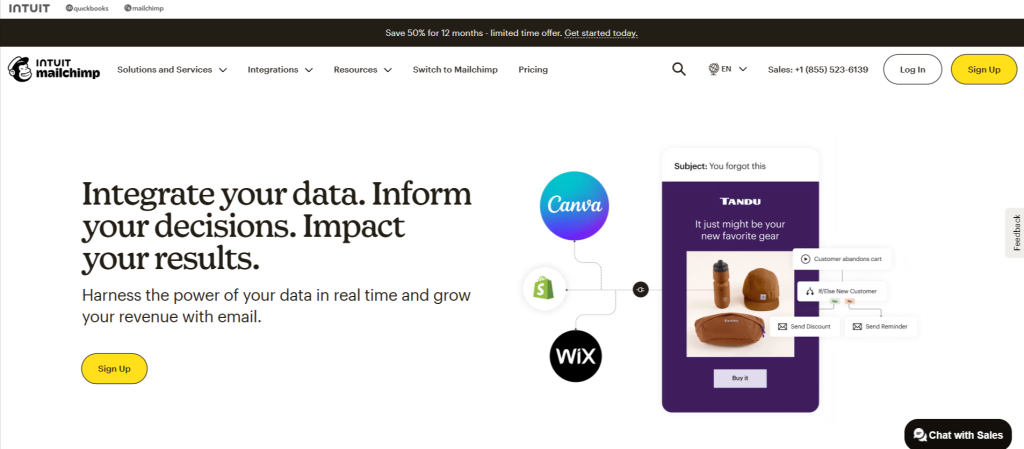
Mailchimp is a favorite marketing platform for many beginners and small enterprises. Providing a unified marketing suite that includes email campaigns, fundamental automation, audience management, and analytics, Mailchimp ensures its customers will be well-served.
Key Features
- Drag-and-drop email builder with customizable templates
- Pre-built automation workflows and customer journeys
- Audience segmentation, tags, and predictive insights
- A/B testing and performance reports
- Integrations with WordPress, Shopify, WooCommerce, and more
Pros and Cons
| Pros | Cons |
| Easiest for Beginners | As your list increases, costs rise |
| Many templates and integrations are available | Less automation with cheaper packages |
| Strong analytics and deliverability | Advanced features require higher-tier plans |
Best For
An easy platform for small enterprises, startups, and bloggers who want to use a well-known platform.

Power Your Email Marketing with Reliable WordPress Hosting
Your email campaigns perform best when your website loads fast, stays secure, and never goes offline. With Hostonce WordPress Hosting, you get optimized performance, strong security, and seamless integration with all major email marketing platforms.
2. Constant Contact
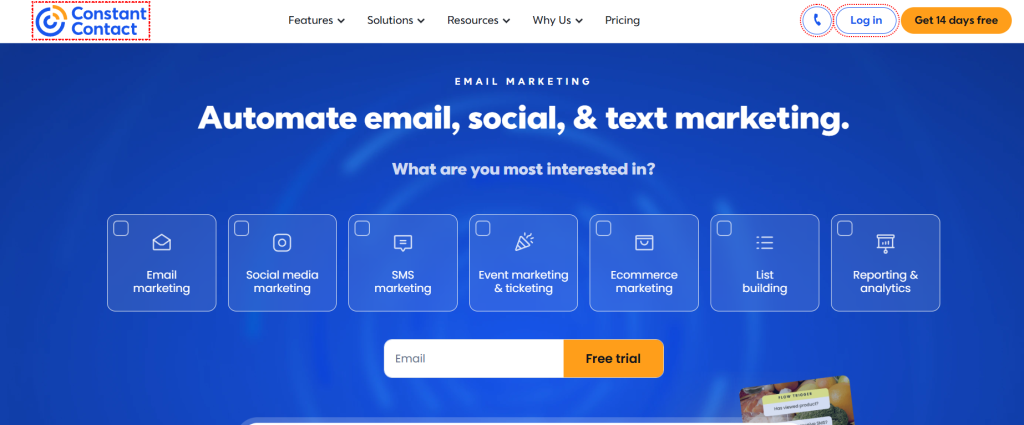
Constant Contact was made for businesses looking for an easy and reliable method to send newsletters and announcements. Additionally, Constant Contact emphasizes ease of use and customer support for crucial email marketing functions without overwhelming customers.
Key Features
- Easy-to-use email editor with a variety of templates
- Management and segmentation of multiple contact lists
- Tools for marketing events and managing RSVPs
- Integration for social media posting and advertising
- Engagement and interaction tracking and reporting
Pros and Cons
| Pros | Cons |
| Beginner-friendly and easy to use | No fully free plan after trial |
| Training materials | Poorly rated automation features |
| Tools for events and nonprofits | More expensive than expected |
Best For
Contact creator is the best email marketing for small business and local organizations that are nonprofits and value hands-on support and simplicity.
3. Brevo (formerly Sendinblue)
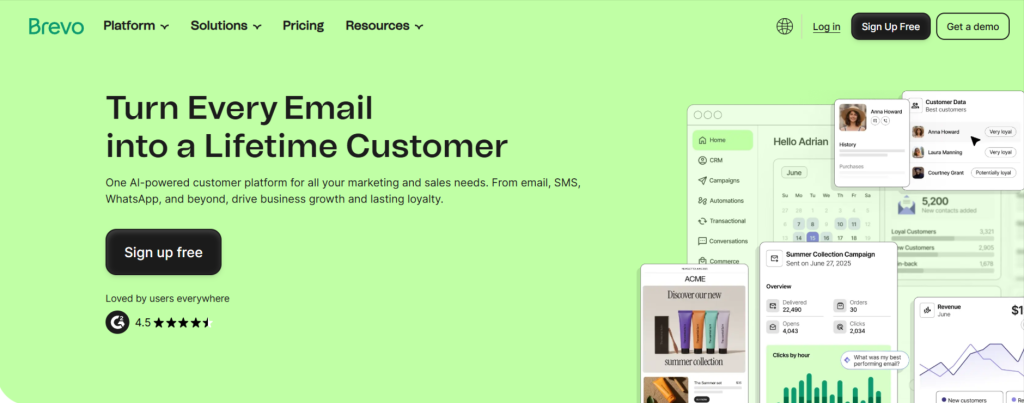
Brevo is a flexible email marketing service that is budget-friendly and goes beyond email with SMS, automation, and CRM tools. Brevo’s pricing is email volume-based and not number of contacts. This is an effective option for businesses looking to grow.
Key Features
- Control your email and SMS campaigns all in one location
- More advanced automation sequences and behavioral starts
- Includes support for transactional emails
- Built-in CRM along with contact data and list management
- Performance analytics and tracking
Pros and Cons
| Pros | Cons |
| Free plan and pricing overall are more budget-friendly | Not all email editor options are great |
| Automation features offered at a low price are great | Fewer email templates are offered |
| Billing is based on the number of emails sent | More advanced features require a learning curve |
Best For
Companies in Ecommerce, small to mid-sized businesses, and startups that need sophisticated automation at more affordable prices
4. HubSpot Email Marketing
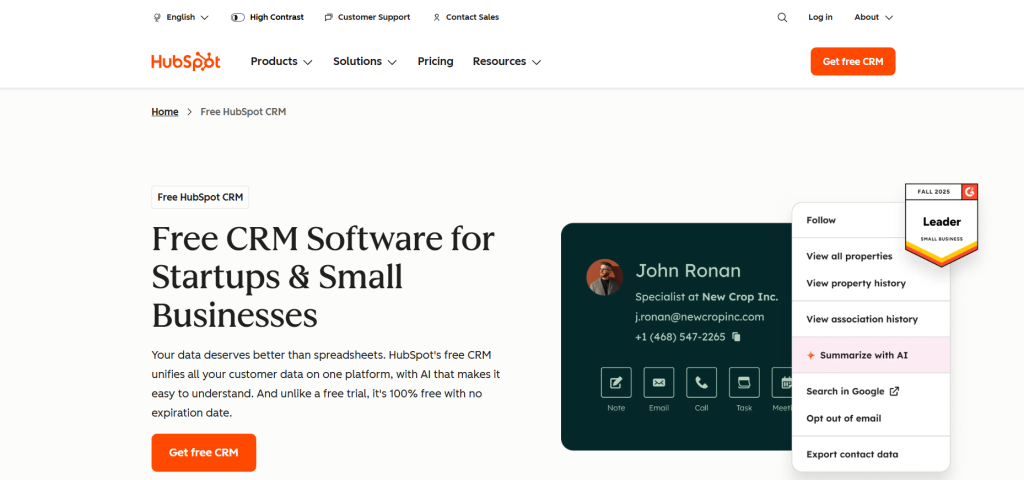
HubSpot Email Marketing is one segment of HubSpot’s overall CRM and marketing solution. It brings the ability to do advanced segmentation of email campaigns, which gives the user the ability to do personalized email campaigns at scale. Moreover, this is useful for lead nurturing and marketing through the customer lifecycle.
Key Features
- Customization of segmentation powered by CRM
- Responsive email templates with a drag-and-drop editor
- Automation and advanced workflow builder
- Comprehensive analytics and A/B testing
- Native integration with HubSpot CRM, sales, and service tools
Pros and Cons
| Pros | Cons |
| In-depth integration with CRM data | As needs expand, it can get pricey |
| Excellent marketing with automation and personalization | Higher-tiered plans for advanced features |
| Well adapted for expanding teams | Very small lists may see it as overkill |
Best For
Teams that wish to tightly integrate a CRM and email marketing, B2B companies, and growing businesses.
5. ActiveCampaign
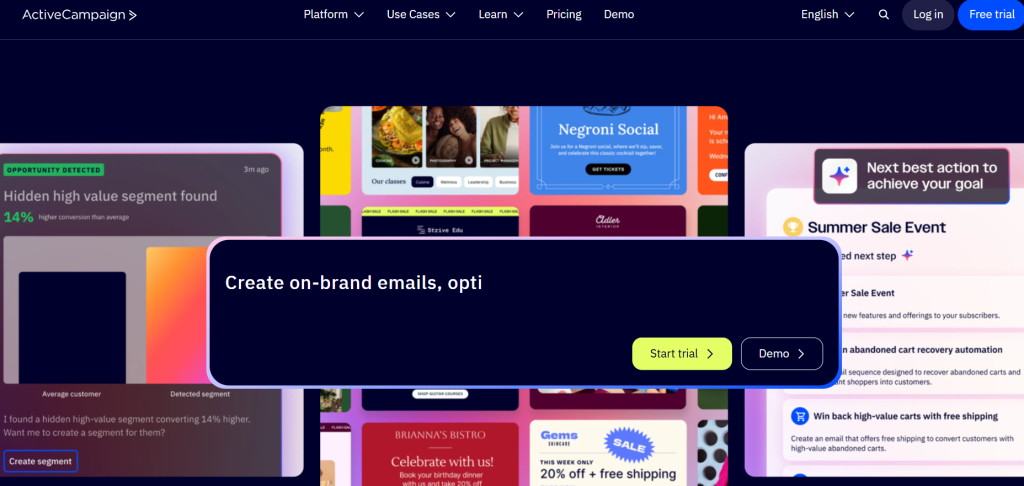
Automation and segmentation are the flagship features for ActiveCampaign, as it also includes features beyond just email marketing. It has CRM automation and customer experience automation, making it a full suite.
Key Features
- Workflows with automation and advanced triggers
- Dynamic content and behavioral tracking
- Sales automation with integrated CRM
- Predictive email sending with A/B testing
- Connections to third-party eCommerce tools
Pros and Cons
| Pros | Cons |
| Best automation in the industry | This requires a steeper learning curve |
| Segmentation down to the finest details | No free tier plans |
| Campaign personalization is excellent | It may feel a bit complex for those just getting started |
Best For
Businesses that rely on heavy automation and personalization, and SaaS companies with advanced marketing needs.
6. ConvertKit
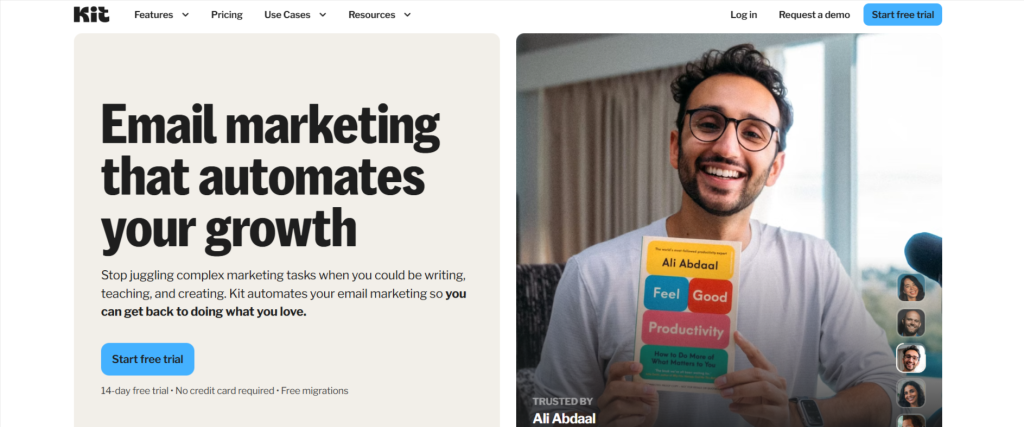
ConvertKit was specifically built for creators, bloggers, and educators. Moreover, ConvertKit was built with simplicity and automation that is effective and easy to understand.
Key Features
- Designed to visualize automation tailored for creators.
- Subscriber management that is tag-based.
- Opt-in forms alongside landing pages.
- Email streaming alongside broadcasting.
- Integrations with multiple platforms and other tools meant for creators.
Pros and Cons
| Pros | Cons |
| Automation is effective and simple to use. | Design options for emails are less varied. |
| Features designed for creators and their specific needs. | Advanced reports are not available. |
| Strong deliverability is offered to creators. | Large eCommerce shops are not a good option for this software. |
Best For
Bloggers, content creators, YouTubers, and creators of online courses.
Get Professional Email Hosting for Better Deliverability
Even the best email marketing platform needs a reliable email foundation. Hostonce Email Hosting gives you secure, professional email accounts that improve credibility and brand trust—perfect for business communication and campaign management.
7. AWeber
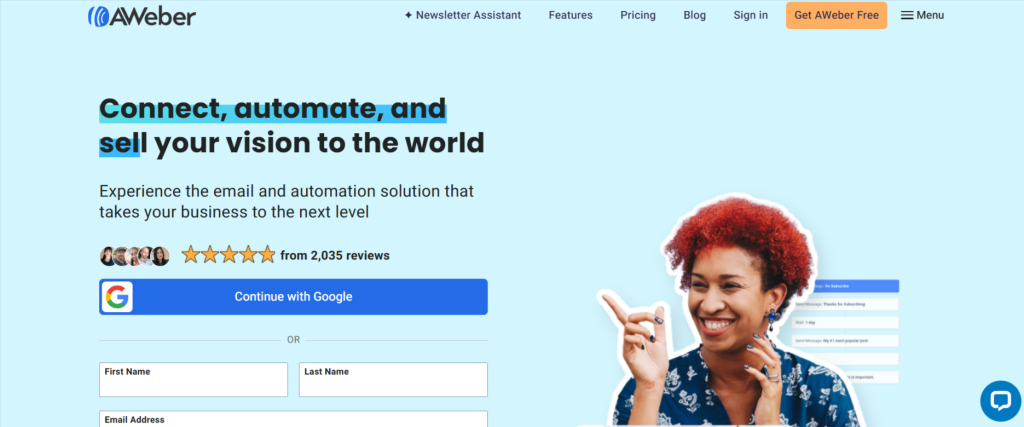
AWeber is one of the oldest platforms available for email marketing, while offering usable marketing tools and reliable email delivery. Furthermore, AWeber is one of the simplest platforms and offers dependable autoresponder functionality.
Key Features
- A drag-and-drop editor with pre-made email templates.
- Basic automation and autoresponders.
- Automation via segmentation of the lists and tagging.
- Support for AMP in emails.
- Tracking and analysis of the performance is available.
Pros and Cons
| Pros | Cons |
| The setup process is easy, and the platform is simple to use. | Automation is limited. |
| Deliverability is good. | Dated interface. |
| A free option is available for smaller lists. | For advanced marketers, it is not a good fit. |
Best For
Users who want simple, reliable email marketing without advanced automation are the best fit for this software.
8. GetResponse
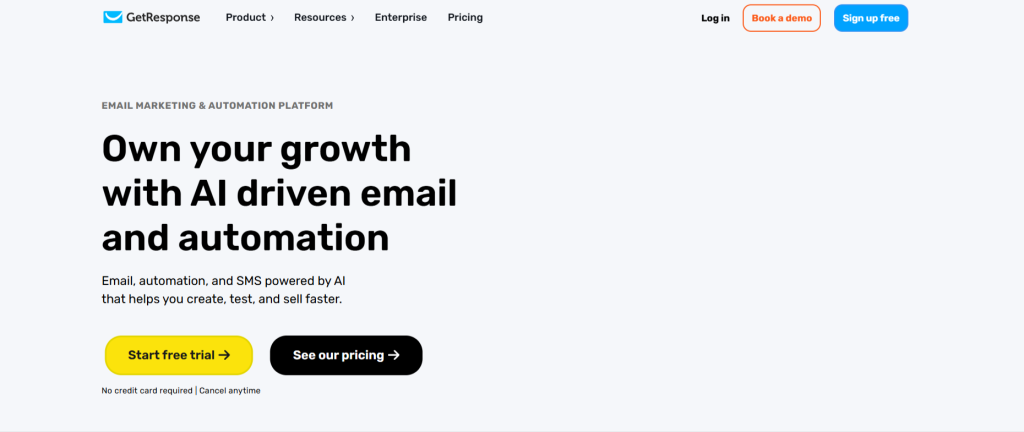
Combining automated email marketing with innovative tools for automation, landing pages, and webinars, GetResponse is a one-stop marketing solution. Businesses that require more than newsletters can use GetResponse’s marketing suite.
Key Features
- Utilize responsive templates and drag-and-drop editors, and use them
- Detailed analytics and A/B testing
- Automation in marketing is advanced
- Forms and landing pages are included
- Funnels and webinars
Pros and Cons
| Pros | Cons |
| All-in-one marketing solution | The interface can be overwhelming |
| Automation is strong | More expensive plans are required for additional features |
| Webinars and funnels are included | The price goes up as your list grows |
Best For
Small to mid-sized businesses and marketers who want email, automation, and webinars in one platform.
9. Klaviyo
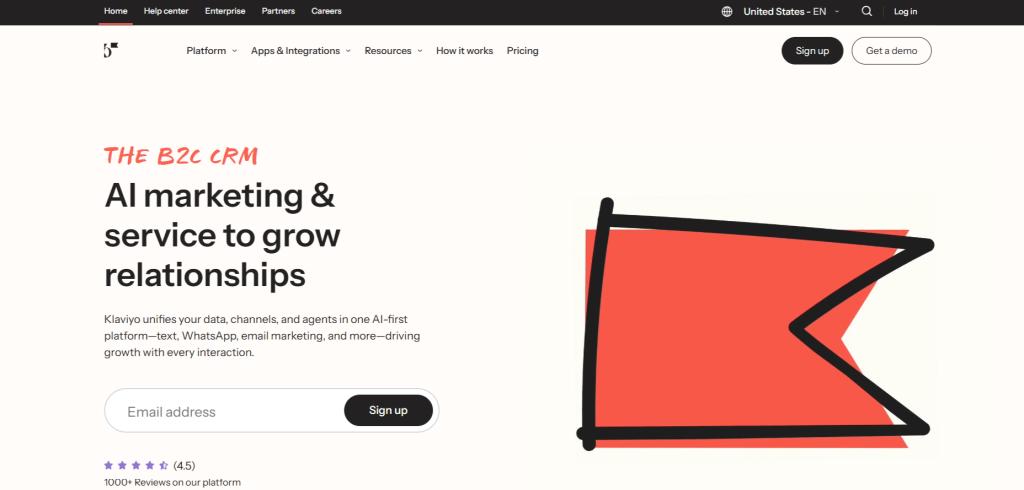
Klaviyo is a data-driven marketing platform specializing in email marketing. It serves eCommerce businesses. It gets a one-up by building data-driven strategies based on user behavior and purchase data to develop optimization value-centric campaigns.
Key Features
- Maximally embedded in Shopify, WooCommerce, and BigCommerce
- Behavioural customized advanced segmentation
- Highly effective automation for both abandoned and post-purchase flow
- Merging SMS and emails for marketing
- Profit-driven analytics
Pros and Cons
| Pros | Cons |
| Great for eCommerce automation | Can get pricey for large volumes of contacts |
| Highly segmented customer insights and data report | Not suitable for non-E-commerce automation |
| Strong SMS and EMAIL automation | Usually can take a while to learn |
Best For
eCommerce and online retailer aiming at increasing customer lifetime value
10. Campaign Monitor
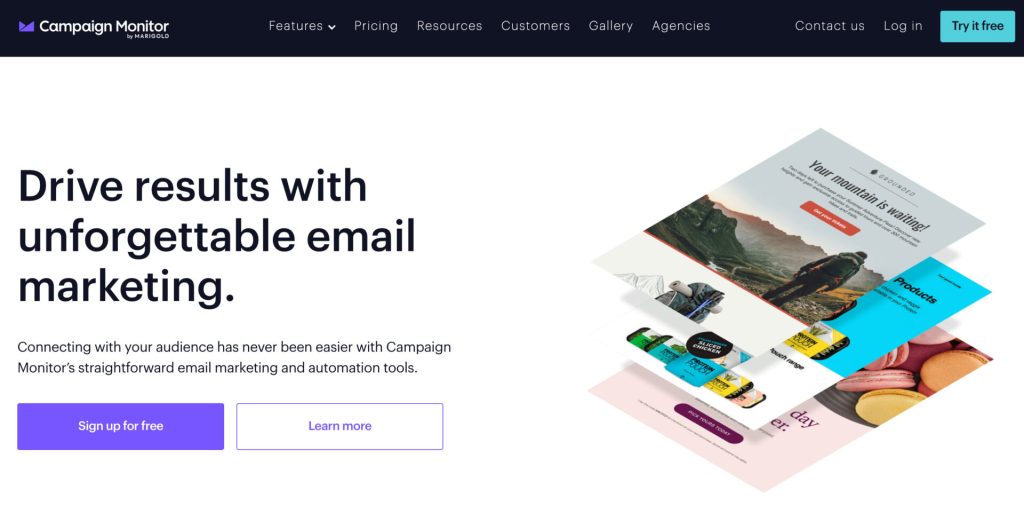
Focuses on standout email marketing campaigns. A clean and clear user experience is a strong factor of Campaign Monitor, and therefore, a brand consist of presentation and visuals gets no better email marketing automation than Campaign Monitor.
Key Features
- Professionally designed email marketing campaign templates
- Drag-and-drop visuals are very easy to use
- Automation for journey-based email marketing campaigns
- Segmentation and personalized lists
- Campaign analytics
Pros and Cons
| Pros | Cons |
| Great user experience | Not as competitive on automation as other platforms |
| Simple and intuitive to use | Permanent free accounts are not available |
| Excellent email deliverability | Can have less advanced integrations |
Best For
Design-centric brands, agencies, or marketers who highly value design elements and ease of use
11. Drip
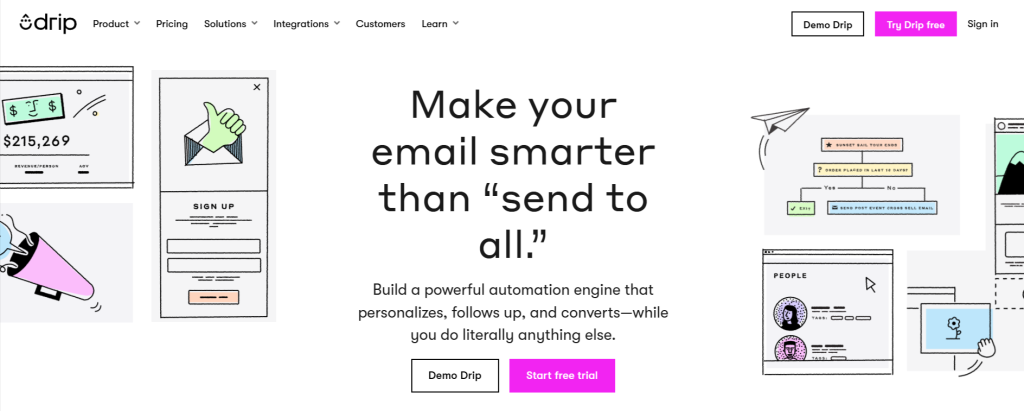
Drip specializes in e-Commerce and revenue-driven companies. They automate customer journeys and behavioral automation rather than simply sending campaigns.
Key Features
- Advanced visual automation builder
- Deep E-Commerce integrations
- Behavior-based segmentation
- Inform revenue attribution and analytics
- Email and SMS automation
Pros and Cons
| Pros | Cons |
| Great automation for e-commerce | More complex than other platforms for beginners |
| Tracking customer journeys is done well | Higher price for small businesses |
| Tracking analytics focused on revenue | No free plan |
Best For
eCommerce brands and online businesses that rely on advanced customer journey automation.
12. Moosend
Moosend is one of the most affordable email marketing platforms with a focus on advanced automation. Served small and mid-sized businesses around the globe and is popular with budgets in the lower range, with advanced features expected. They deliver high deliverability rates, and marketers can build behavior-based campaigns with little to no technical prowess.
Key Features
- You can utilize a drag-and-drop email editor that offers responsive email templates
- Integrated automation with triggers and workflows
- Segment lists and personalize to a further extent
- Generate landing pages and subscription forms
- Campaign reports and real-time analytics are available
Pros and Cons
| Pros | Cons |
| Automation capabilities with low-cost price points | Native integrations are very limited |
| Provides a good user experience with not much learning curve | No permanent free tier |
| Deliverability and analytics are good | Active users can expect fewer templates available |
Best For
Business automation tools available at low costs target small businesses, bloggers, and startups.
13. MailerLite
With simplicity and affordability in mind and a focus on performance, MailerLite has developed into a trusted email marketing platform. Modern features such as automation and landing pages can be utilized with the help of over 1 million global customers. New businesses and creators will gravitate towards the platform due to the attractive free plan.
Key Features
- Have access to a user-friendly drag-and-drop email editor
- Individual email flows and automation
- Landing pages and forms, as well as pop-ups
- Ability to segment and tag subscribers
- Campaign analytics are available in detail
Pros and Cons
| Pros | Cons |
| You’ll find a generous free plan | Fewer options are available for automation |
| Very easy to use | Limited CRM features |
| Fast setup and good deliverability | Not ideal for complex workflows |
Best For
Complex workflows are not needed for smaller businesses, creators, and startups who can be considered beginners on a budget.
14. SendGrid
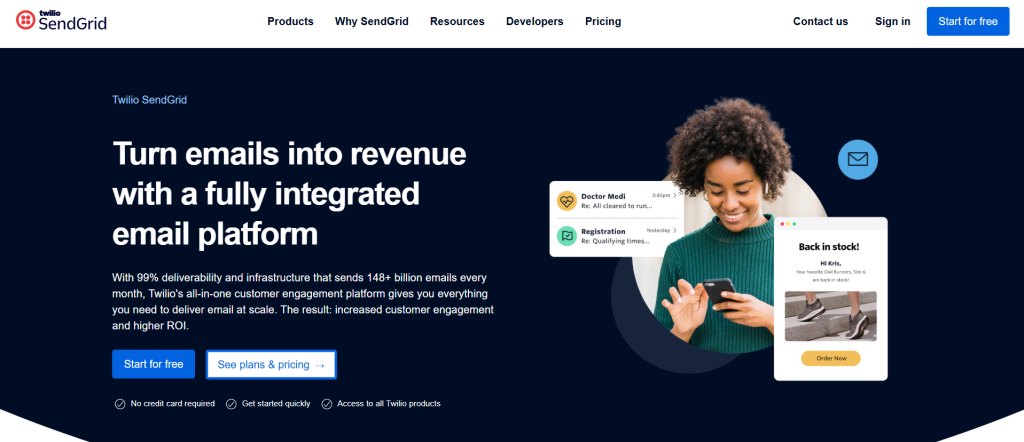
More than 100 billion emails are sent every month from SendGrid, which is a cloud-based email delivery system valued for its reliability and scalable systems. For its users, SendGrid offers tools for creating campaign emails and can also function as an email transactional system. SendGrid is also valued for its scalable systems and reliability, and is backed by Twilio.
Key Features
- Infrastructure for sending a large number of emails
- Support for transactional and marketing emails
- Email APIs and SMTP relay systems
- Tools for monitoring email systems and reputation
- Tools for analytics and real-time monitoring
Pros and Cons
| Pros | Cons |
| Extremely reliable at scale | Not very beginner-friendly |
| Users can use a very powerful API system | Users may have constraints on design and automation tools |
| High deliverability rates | The company’s marketing features have a basic design. |
Best For
Best for SaaS companies, developers, or any other company that is sending high volumes of emails that are transactional.
Expert Tip
Before committing to any email marketing platform, map out your first 3–5 automated emails (such as a welcome sequence or abandoned cart flow). If the platform makes these workflows easy to build and track, it will scale with your strategy—if not, it will become a limitation as your list and revenue grow.

15. Zoho Campaigns
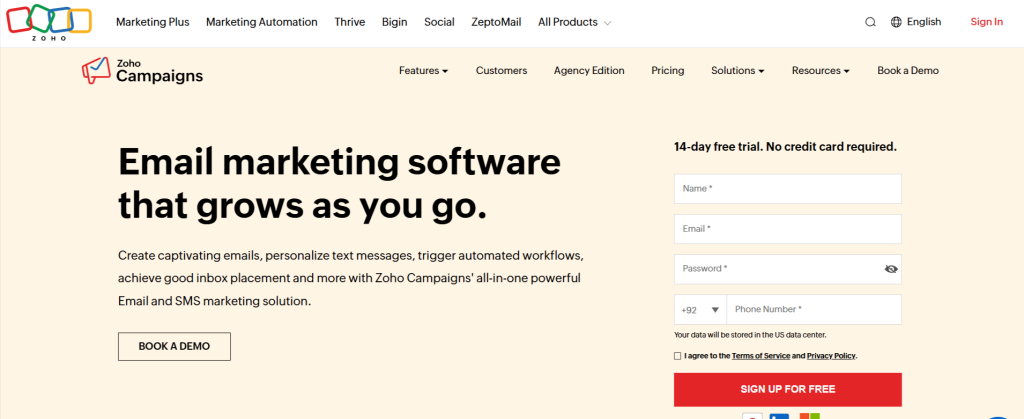
For cost-effective email marketing with CRM personalization, a lot of small and mid-size companies use Zoho Campaigns. Zoho Campaigns integrates well with Zoho CRM.
Key Features
- Availability of email editor & email templates
- Based on CRM email contacts & segmented
- Marketing automation workflows & autoresponders
- Testing & measuring analytics
- Integration with Zoho CRM & others
Pros and Cons
| Pros | Cons |
| Great benefits with Zoho | Outdated user interface |
| Good CRM consolidation | Automation limited |
| Good attribution | Fewer templates available |
Best For
Small & Medium businesses are existing users of Zoho CRM & other applications.
Comparison Table: Best Email Marketing Platforms at a Glance
The table summarizes the most popular email marketing services in parallel, letting you compare email marketing services in terms of their cost, automation, ease of use & most appropriate use cases.
| Platform | Free Plan | Starting Price* | Automation Level | Ease of Use | Best Use Case |
| Mailchimp | Yes | From ~$13/month | Medium | Very Easy | Beginners and small businesses |
| Constant Contact | No (trial only) | From ~$12/month | Low | Very Easy | Local businesses and nonprofits |
| Brevo (Sendinblue) | Yes | From ~$25/month | High | Easy | Budget-friendly automation and SMS |
| HubSpot Email Marketing | Yes | From ~$20/month | Very High | Medium | CRM-driven B2B marketing |
| ActiveCampaign | No | From ~$29/month | Very High | Medium | Advanced automation and personalization |
| ConvertKit | Yes | From ~$15/month | Medium | Easy | Creators and bloggers |
| AWeber | Yes | From ~$15/month | Low–Medium | Easy | Simple email campaigns |
| GetResponse | Yes (trial) | From ~$19/month | High | Medium | Funnels, webinars, and automation |
| Klaviyo | Yes (limited) | From ~$20/month | Very High | Medium | eCommerce and SMS marketing |
| Campaign Monitor | No | From ~$11/month | Medium | Very Easy | Design-focused email campaigns |
| Drip | No | From ~$39/month | Very High | Medium | eCommerce customer journeys |
| Moosend | No (trial) | From ~$9/month | High | Easy | Affordable automation |
| MailerLite | Yes | From ~$10/month | Medium | Very Easy | Startups and small businesses |
| SendGrid | Yes | From ~$19/month | Low–Medium | Medium | Transactional and high-volume emails |
| Zoho Campaigns | Yes | From ~$4/month | Medium | Easy | Zoho CRM users |
*Pricing is approximate and may vary based on list size and features.
How to Choose the Right Email Marketing Platform
When choosing an email marketing platform, just looking at popularity is not enough. One needs to look at the platform’s strengths and see if they align with your particular needs, audience size, and business goals. Below is a comprehensive overview to help you with your specific situation.
For Small Businesses and Startups
Small businesses and startups need email marketing platforms that are fairly priced, user-friendly, and able to grow with them. When looking at your options, consider the following:
- Look for platforms that incorporate ease of use. You want a platform that provides an easy-to-use dashboard, has drag-and-drop functionality, and has pre-built email templates. This way, you are able to launch campaigns quickly, with little to no technical knowledge.
- Look for platforms that offer automation. When you incorporate basic automation, such as autoresponders for welcome sequences and follow-up sequences, you are able to remain engaged with your audience while focusing on other business activities.
- Look for platforms that incorporate basic functionality. You should try to find software that has a strong free plan available, or a free tier for low-cost options, so you don’t go broke as your contact list starts to grow.
Overall, for most startups and smaller teams, platforms like MailerLite, Moosend, Mailchimp, and Constant Contact provide a good blend of simplicity, cost, and basic functionality.
Secure Your Brand with the Right Domain Name
Your email marketing success starts with a professional domain that builds trust and boosts deliverability. With Hostonce Domain Services, you can register and manage the perfect domain for your brand.
For Bloggers and Creators
Bloggers, content creators, and solo entrepreneurs tend to use email marketing to build a community, engage an audience, and sell digital products. Your platform needs to have a focus on ease of use, good flow of automation, and segmentation of the audience.
- Subscriber-centric workflows: The ability to tag a reader according to their interests (e.g., topic preferences) allows you to send relevant content.
- Simple automation: Drip email sequences and automated welcome emails keep your audience engaged even while you sleep.
- Landing pages & forms: Built-in opt-in forms and landing pages help grow your list without needing other tools.
Best fit: ConvertKit, MailerLite, and AWeber are especially creator-friendly with their simple interfaces and creator-focused features like visual automation and easy subscription forms.
For eCommerce Stores
eCommerce online stores require email marketing that enables higher sales, repeat purchases, and retention of customers. That requires sophisticated behavioral automation and good integration with your store platform.
- Abandoned cart and purchase follow-ups: Such automated sequences recover lost sales and increase purchase rates.
- Segmentation by behavior: It greatly increases email relevance to the recipient when different emails are sent depending on their purchase history, browsing behavior, or stage (new, lapsed, etc.) in the customer lifecycle.
- Multi-channel support: Platforms that integrate SMS, push, or social notification channels amplify message delivery.
Best fit: Klaviyo, Drip, and ActiveCampaign stand out in the eCommerce domain for providing advanced automations, seamless integrations with Shopify/WooCommerce, and analytics tailored for profit maximization.
For Enterprises and Agencies
With enterprises and agencies, there is often an accompaniment of large lists, intricate workflows, and numerous clients or divisions. They’ll require strong automation, collaboration, and flexibility in the platform.
- Advanced segmentation & personalization: For the best engagement, personalization needs to be at scale (content, offers, and timing).
- Robust CRM integration: There needs to be an alignment of marketing and sales through the syncing of email data to CRM platforms.
- Analytics & reporting: Reporting enables the measurement of results across clients to be done seamlessly for campaigns upon completion.
- Management for multiple brands: There is an assurance of order in collaboration through multilayered user access, role allocation, and adaptable systems.
Best fit: Tools and flexibility to fit the needs of big teams is accumulated in platforms such as HubSpot Email Marketing, ActiveCampaign Enterprise plans, and optionally Salesforce Marketing Cloud.
Budget vs. Advanced Automation Needs
With most platforms, there is usually a compromise between powerful automation features and price:
- Budget-conscious options: If your email list is new or your budget is limited, platforms with free or cheap starting pricing tiers (such as MailerLite, Moosend, AWeber) are often a more manageable and superior option as they will most likely meet your needs without the higher price tag. They often cover the basic features without overwhelming price tags.
- Automation seekers. In the case of having a strategy comprising of behavioral triggers, sale funnels, campaign automation, and detailed segmentation, prioritize automation (ActiveCampaign, HubSpot, Klaviyo) regardless of the cost.
- Contact vs. volume pricing. Some tools have a pricing model based on the number of contacts (Mailchimp), others, based on the volume of emails or features (Brevo). Pick the pricing model that works best as your list expands.
Email Marketing Platforms vs Email Sending Tools
While their purpose is to send emails, email sending tools and email marketing platforms do very different things. Knowing the differences and similarities will help you select the best tools, or combination of tools, for your business.
Email Marketing Platforms
To help businesses strengthen relationships and increase engagement, email marketing tips are focused on automated emails, campaigns, newsletters, and promotions targeting a list of subscribers who have opted in.
Some of the primary features you can expect in email marketing marketing platforms include:
- Templates and visual editors for campaign creation
- Personalization and audience segmentation
- Automation of workflows (follow-ups, welcome emails, drip campaigns)
- Performance tracking, analytics, and A/B testing
- Opt-in and opt-out compliance tools
Some examples include Mailchimp, ActiveCampaign, ConvertKit, Klaviyo, and MailerLite.
Transactional Email Tools
In contrast, transactional email marketing tools are designed for one-to-one, system-generated emails sent in response to a user’s actions. In contrast to marketing emails, emails sent on these occasions are often sent in real time to customers and are time-sensitive. For instance, sending a password reset link or sending an order confirmation email.
Some features you can expect from transactional email marketing tools are:
- Email delivery via SMTP or API (Application Programming Interface)
- Super high deliverability and speed
- Lack of design and marketing features
- Reliability, logging, and monitoring
Some examples include SendGrid, Amazon SES, Mailgun, and Postmark.
When You Need Each (or Both)
- If you aim to send newsletters, promotional campaigns, onboarding sequences, or lead nurturing over time, then email marketing platforms are your best choice. Such platforms work well with marketing teams, creators, and businesses concentrating on engagement and conversions.
- If your application or website requires sending automated system emails (e.g., account verification, receipts, shipping updates, security alerts), then transactional email tools are your best choice. These tools, when used, are best suited for urgent messages as they provide fast delivery and high inbox targeting.
- Both are best used together when you have an eCommerce store, SaaS product, or large application. Most businesses have an email marketing platform for the promotional activities and customer journeys triggered, while keeping a transactional email service for the emails that are critical for systems. This separation is beneficial as it increases deliverability and compliance and increases performance for both email types.
Final Thoughts
While this is certainly one of the most effective digital channels, email marketing’s success is highly dependent on the platform you choose. Many of these tools are user-friendly, like MailerLite, Mailchimp, and AWeber, but other, more advanced and automated platforms like ActiveCampaign, HubSpot, Klaviyo, and Drip are also available. Each of these platforms was created for a particular audience, and they serve a different purpose; there is no best platform. The best one for you will depend on your exact needs, your audience, your industry, and where you are in your growth journey.
Integrating your email marketing tool with your business objectives is crucial. For creators and bloggers, audience automation and simplicity are important, while eCommerce stores require behavioral design workflows that help drive sales. Enterprises, on the other hand, focus on large volumes with pertinent integrations, analytics, and automation. Choosing a tool without factoring in your objectives can result in excess costs, neglected features, and disengaged audiences.
If you’re starting, undercomplicate things. Use a low-cost, straightforward tool, master your audience, and expand your toolset as your automation requirements, income, and subscriber list grow. The ideal email marketing platform should grow with your company and not hinder it.
New Email Marketing Tools to Boost Your Business Growth
By Favour Brown on May 7, 2026FAQ
Are free email marketing platforms worth it?
Yes. Free plans are ideal for small lists and testing features, but you’ll need a paid plan as your audience and needs grow.
Which platform is best for automation?
ActiveCampaign, HubSpot, Klaviyo, and Drip offer the most powerful automation and behavior-based workflows.
What is the best email marketing platform for eCommerce?
Klaviyo is the top choice for eCommerce, with strong integrations, advanced segmentation, and revenue-focused automation.
Can I switch platforms later without losing data?
Yes. Most platforms allow you to export contacts and data, though automation workflows may need to be rebuilt.

Hostonce is the #1 WordPress Host
Ranked by 930+ customers in G2's Best Software Awards.