



Despite building the best app on the block, you can’t expect it to be successful unless you implement effective marketing strategies to help the target audience recognize, download, and utilize the app.
The app development landscape is highly competitive, and the app stores are rapidly filling up. This makes it difficult for both new and existing apps to attract and retain a user base. This is why app marketing is as important as app development. An effective app marketing strategy helps improve the app store listing, increases visibility, boosts the number of installs, and encourages user retention.

Bulk SMS Marketing Strategies
By Festus Nkopuruk on June 2, 2026The marketing strategy for apps encompasses a broad scope and offers numerous possibilities for improvement. This blog discusses 13 of the most effective advanced mobile app marketing strategies. These strategies help improve app user acquisition, retention, and engagement while leveraging marketing assets to their full potential.
Key Takeaways
- Mobile app marketing involves more than downloads. Focus on acquisition, engagement, retention, and conversions.
- Use ASO, personalization, and deep linking to improve app visibility and user experience.
- Leverage push notifications, referrals, influencers, and retargeting to attract and re-engage users.
- Use A/B testing and automation to improve campaigns and deliver more relevant user experiences.
- Track CPI, CAC, retention, conversion rate, LTV, and ROAS to measure results and refine your strategy.

Launch Your Website Today
No matter which path you choose, you need a strong hosting foundation to grow online. Get secure, fast, and beginner-friendly web hosting to power your digital journey.
What Is Mobile App Marketing?
Marketing an app involves getting people to download and continuously use the app. This process encompasses the entire consumer journey, including the initial exposure to the app, as well as the post-purchase relationship with the consumer.
Marketing an app usually involves the following:
- App awareness: This involves letting the consumer market become aware of the existence of the app through various marketing channels.
- User acquisition: At this stage, the goal is to have members of the consumer market complete the installation of the app on their devices. Various marketing strategies are employed to accomplish this.
- Activation: After the app has been downloaded and installed, the next goal is to have the consumer use the app to perform the key function of the app.
- Engagement: Once the consumer has performed the key function of the app, the next goal is to have the consumer use the app regularly to perform various functions.
- Retention: The goal at this stage is to ensure that consumers use the app instead of uninstalling it. Achieving this goal usually involves offering consumers new functions and features of the app.
- Monetization: The goal at this stage is to realize a financial return on the marketing efforts for the app. Various models can be employed to achieve this goal.
13 Advanced Mobile App Marketing Strategies
In order to be successful in the app market, you need to look at app marketing the same way you look at user retention and data. There are many opportunities for consent-based marketing, including app personalization, distribution, and communication. Here are a few strategies focused on user acquisition and retention.
1. Build a Data-Driven User Acquisition Strategy
Strategizing user acquisition means determining the group of users who not only interact with the app but also make purchases and/or retain their app use. Think about user wants and needs as well as user location and interest.
Much like a traditional business, you need to analyze where your users come from and which user acquisition strategies are the most efficient. Track user retention, CPI, and CAC to determine which strategies bring the most user engagement.
2. Take App Store Optimization Beyond Basic Keywords
App Store Optimization (ASO) is important for ranking and visibility of app listings. Similar to traditional SEO, incorporating relevant keywords and phrases in app descriptions is important. However, ASO allows for greater creativity and flexibility since app descriptions are often very long and can include screenshots.
In an app listing, include preview videos and screenshots that illustrate the app’s key features. Be sure to test different features to see what increases user engagement the most.
3. Create Personalized User Experiences
Relevant content and suggestions help engage users and increase conversion rates. Knowing users’ preferences, location, and behavior helps apps change the type of content they recommend and how that content is presented.
One way to increase engagement is to segment users and create groups based on characteristics such as how often they use the app, how recently they used the app, and whether they make in-app purchases.
4. Use Deep Linking to Improve Conversions
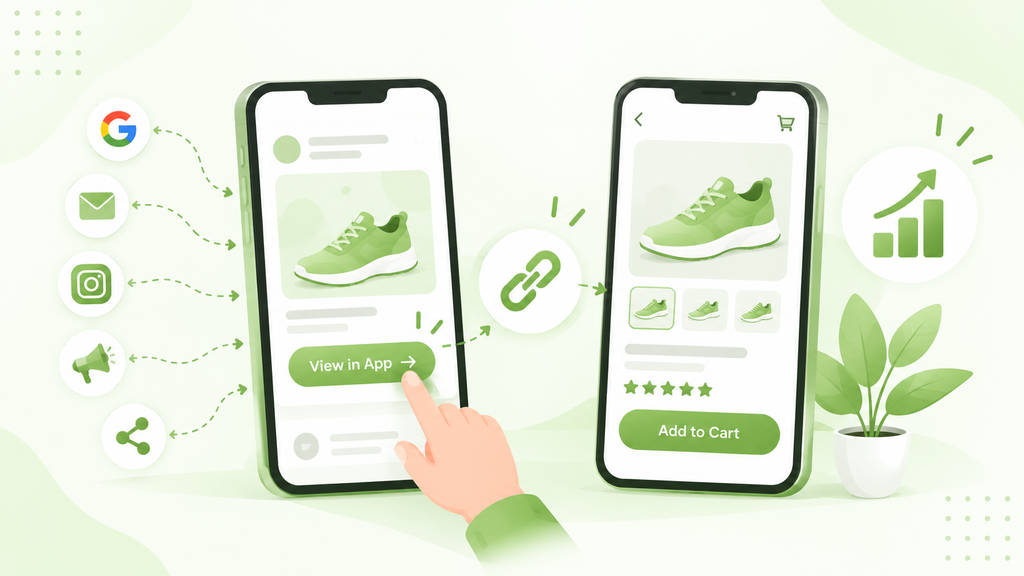
Using deep links within the app, users can be directed to a specific section or feature rather than being taken to the app’s homepage.
As such, deep links can be effectively utilized to reduce the distance between an advertisement and the desired user action within the app. Deep links can be used for app store advertisements.
- Email marketing
- Social media advertisements
- Paid internet search result placements
- Affiliate marketing
5. Develop a Strategic Push Notification Campaign
Push notifications are a great way to keep your app on your customer’s mind; however, just as easily, you can lose your customer for life with too many and/or irrelevant notifications. To increase the relevancy of your notifications to your customer, consider your customer’s purchase history, their app usage, and preferences.
Send your notifications at the most relevant times to your customers to ensure they don’t disable notifications for your app or uninstall your app.
6. Turn In-App Messaging Into a Marketing Channel
Use in-app messaging to communicate with users as they engage with your app. Similar to other messaging methods, in-app messages can be used to communicate with users during various stages of their relationship with your app, such as during the onboarding process, to notify users of new features, or to promote in-app purchases.
Because users engage differently with an app, messages can be personalized based on the user journey. For instance, a user who just signed up may need a short tutorial on how to use a specific feature of the app, while a user who previously purchased a product may receive a message about a related product.
Grow Online with Confidence
Take the next step toward building your digital presence. From hosting to tools that support your growth, Hostonce has everything you need to succeed—whether you’re starting a blog or scaling a business.
7. Build a Referral and Incentive Program
Encourage your current users to invite their friends to use your app by offering rewards to users who refer a friend who later signs up and uses the app. Examples of rewards may include discounts on an upcoming purchase, credits to the user’s account, or early access to new features.
From the referred user’s perspective, the app should require as few steps as possible to use the referral link and share it with others. It may also be helpful to develop a system to automatically track and monitor a given user’s referral activity to gain insights into the value the user referral program creates.
8. Use Influencer and Creator Partnerships

Influencer marketing can help you expand to a new user base by promoting your application to users who are interested in your competency. It is better to work with many smaller influencers that are more relevant to your user base compared to fewer larger influencers.
There are many ways creators can work with your app. They can provide demos, tutorials, or examples of how they have integrated the app into their daily activities. You can generate unique links or provide creators with referral codes to track app installations and/ or conversions.
9. Retarget Users Who Do Not Convert
It is normal for a user to download your app and not take the next step to make a purchase or register. These are known as ‘conversions’. Retargeting allows you to reconnect with users who have shown interest in your app but have not completed a conversion.
Every user needs to be segmented. For example, a user who has items in their shopping cart but has not completed the purchase needs to be reminded of the items they wish to purchase. A user who has not purchased in a long time needs to be invited to make a purchase and may need to be given a special offer.
10. Experiment With App Marketing Automation
Marketing automation allows you to engage with users based on actions they took and messages they received. Onboarding a new user can be automated by sending a message to the user to remind them of the next action they need to take.
Users can be automatically engaged with a message based on the last action they took. A new user may be sent a message to remind them of the next action to take. An automated message may be sent to a user to remind them of a product they viewed but did not purchase.
11. Use A/B Testing to Improve App Performance
A/B testing allows you to test multiple components of your app to identify the version that helps users take the next action. The components may include the message within a push notification or one of the screens within the app.
You may use A/B testing to identify the message that is most likely to help a user take the next action within the app. This may also include testing what offer or CTA is most likely to help a user complete the action of making a purchase.
To effectively measure your marketing campaign, consider one main goal and one main variable at a time. For example, the goal could be more app registrations or sales, and the variable could be a new campaign to strengthen user engagement. Understanding the results of your campaigns helps you modify your future marketing campaigns and product offerings.
12. Build a Strong App Retention Strategy
The goal of a user retention strategy is to get users to return to your app and use it past the first session. User retention strategies for apps focus on improving the user onboarding process. Other retention strategies include the use of relevant content and personalized recommendations, and the implementation of user loyalty programs.
It is important to track user retention and churn rates to identify areas of your app that are not effectively meeting the needs of your users.
13. Connect App Marketing With Your Overall Digital Strategy
Ultimately, your app should integrate well with other online marketing channels. To help get the app, a marketing website can feature a CTA to download the app. Paid advertising can be used to promote your marketing website and app. Email marketing and social media marketing can both be used to cross-promote app features. The goal is to create a cohesive marketing experience that builds brand recognition.
Key Mobile App Marketing Metrics to Track
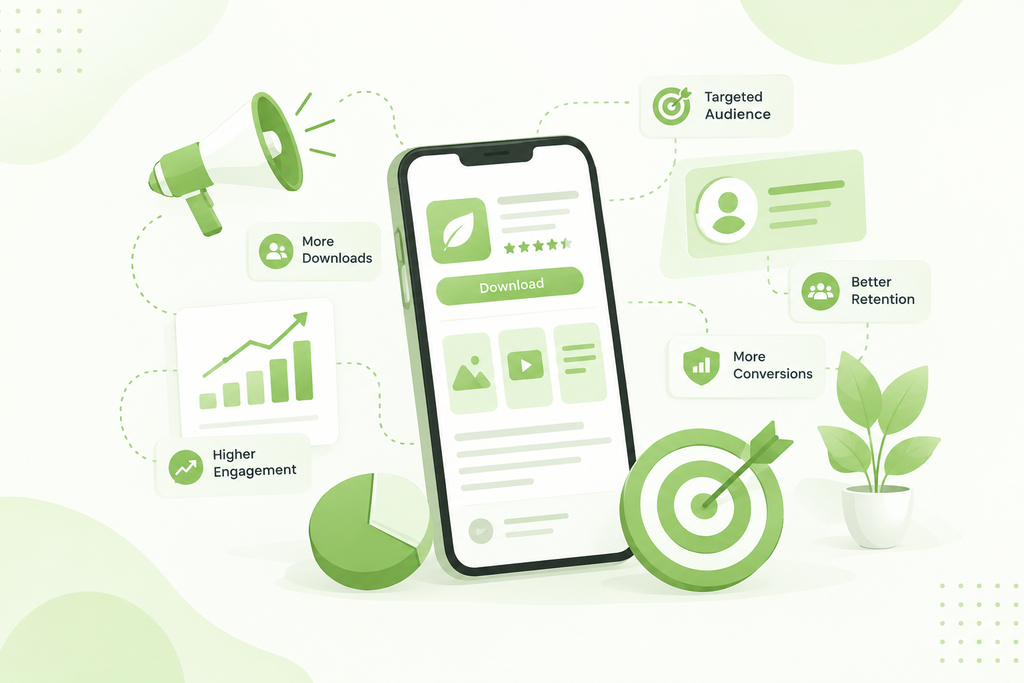
Understanding the correct metrics to analyze mobile app marketing campaigns tells businesses if their campaigns are successful. One important metric is the number of app downloads; however, focusing on the post-download user experience and app economic value is important as well.
- App Installs: The number of times the app was downloaded.
- Cost per Install (CPI): Average cost to provide an app download.
- Customer Acquisition Cost (CAC): Average cost to acquire a customer.
- Activation: The percentage of users who complete a specified action for the first time.
- Daily Active Users (DAU) / Monthly Active Users (MAU): The number of users who interact with the app within a day/month, respectively.
- Retention: The percentage of users who return to use the app within a defined time window.
- Churn: The percentage of users who stop using the app within a defined time window.
- Session: The length of time a user interacts with the app.
- Conversion: The percentage of users who complete a specified action, for example, making a purchase.
- Lifetime Value (LTV): The total revenue a user generates for the business.
- Return on Ad Spend (ROAS): The ratio of revenue to the cost of an advertising campaign.
Common Mobile App Marketing Mistakes to Avoid
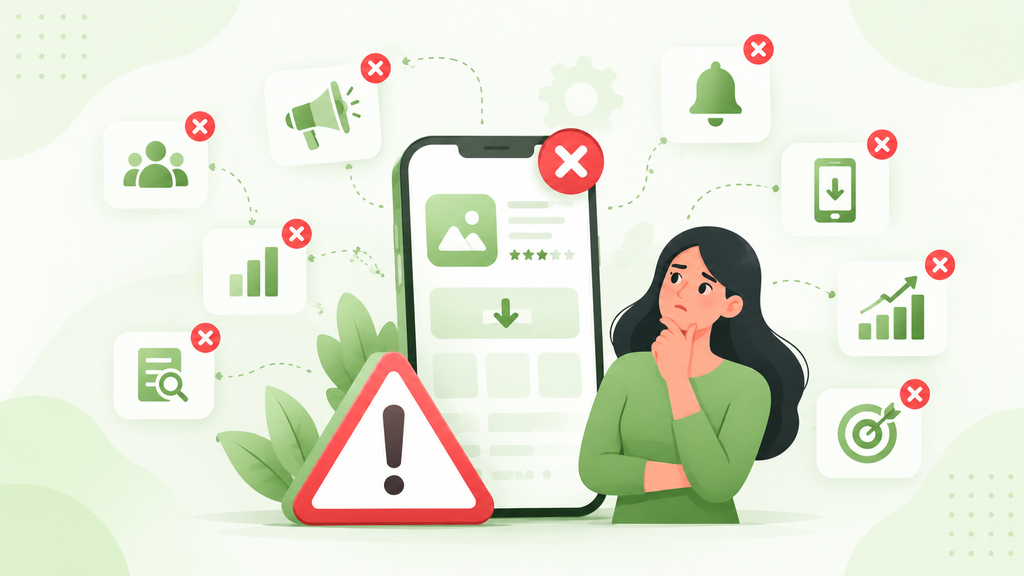
Even well-planned campaigns can underperform when businesses focus on the wrong priorities. Avoiding common mistakes can help improve both user acquisition and long-term engagement.
- Focusing only on downloads: A large number of installs does not guarantee active or paying users.
- Targeting everyone: Define a specific audience instead of trying to reach every potential user.
- Sending too many push notifications: Excessive notifications can annoy users and lead to disabled notifications or uninstalls.
- Ignoring app store optimization: Poorly optimized listings can make it harder for users to discover the app.
- Not tracking user behavior: Without behavioral data, it is difficult to understand what users need or where they drop off.
- Running campaigns without testing: A/B testing can help identify which messages, offers, and creatives perform better.
- Failing to re-engage inactive users: Create targeted campaigns to bring back users who have stopped using the app.
- Measuring vanity metrics: Focus on metrics connected to meaningful outcomes, such as retention, conversions, revenue, and customer value, rather than numbers that look impressive but provide little insight.
Conclusion
The world of mobile app marketing is wide and demands a variety of approaches to effectively draw the right users and keep them coming back. Along with employing different strategies to maximize a mobile app’s visibility and lead the target audience to its virtual doorstep, it is vital that businesses consider ways to strengthen their customers’ mobile experience and to ensure user loyalty.
Dedicated mobile app hosting facilitates optimal performance of mobile applications. If your mobile business is rapidly expanding, Hostonce’s hosting services can provide additional flexibility and control over your app.
FAQs
What is mobile app marketing?
Mobile app marketing encompasses various activities aimed at improving the virtual presence of a mobile app, optimizing it for greater discoverability, attracting customers, and maximizing engagement and retention.
What are the top strategies for mobile app marketing?
Different approaches and strategies for mobile app marketing include, but are not limited to: Data-driven user acquisition; App Store Optimization (ASO); Personalization; Referral programs; In-app purchases; Retention campaigns; A/B testing; and other user experience (UX) improvements.
What can I do to get more people to download my app?
Add to your mobile app description the positives potential users will see with your app. Moreover, optimize your listing for search and consider your audience when determining your promotion strategy (paid or no paid). You can partner with app endorsers and get your app users to recommend your app. See where your quality app installs occur with Acquisition Channels.
What can I do to get users to continue using my app?
Get your users to come back to your app by creating an app that accomplishes its purpose the first time a user launches it. Other ways to accomplish this are to provide users with content based on their preferences. Moreover, utilize push notifications, introduce app features, and utilize re-engagement strategies.
What should I consider when thinking about the metrics related to my app?
A few of these are app installs, cost per install, customer acquisition cost, and app activation rate. Furthermore, these include daily/monthly active users, average session duration, conversion rate, app user LTV, and app ROI.

TikTok Influencer Marketing in 2026: A Guide to Success
By Festus Nkopuruk on August 7, 2025
Hostonce is the #1 WordPress Host
Ranked by 930+ customers in G2's Best Software Awards.
