





Marketing on LinkedIn is a great way for businesses to showcase their expertise, build their network, and reach people who can impact their sales opportunities. Creating and implementing a LinkedIn marketing strategy can help a business reach its target audience and achieve its marketing objectives.
With a clear strategy, a business can build its brand, improve its recognition, and develop its lead generation and advertising efforts. Each business will need to evaluate and understand its target audience and the marketing goals that they hope to achieve. In this article, we will discuss various strategies for marketing on LinkedIn.

What is Consent-Based Marketing and Why Does It Matter for Your Business?
By Festus Nkopuruk on May 25, 2026Key Takeaways
- Using a LinkedIn marketing strategy helps businesses gain recognition, reach people who can impact their sales, and create their lead generation and marketing efforts.
- A well-designed LinkedIn business page provides potential customers with important information about a business and aids in a business’s visibility.
- Writing and sharing pertinent information about a business’s industry helps a business achieve marketing goals and creates a reputation for the business as a reliable and trustworthy source.
- Engaging and supporting other people’s posts can help a business achieve marketing goals and build its professional relationships.
- Analyzing and interpreting marketing campaign results can help a business achieve its marketing goals and improve its campaigns.

Grow Online with Confidence
Take the next step toward building your digital presence. From hosting to tools that support your growth, Hostonce has everything you need to succeed—whether you’re starting a blog or scaling a business.
What Is a LinkedIn Marketing Strategy?
A LinkedIn marketing strategy helps a business refine the use of LinkedIn to entertain and engage with its consumers and help in achieving its digital marketing objectives. In this strategy, a business decides what it wants to communicate with its audience, the type of content it wants to share, and how it will measure the success of its LinkedIn marketing efforts.
There are several marketing objectives a business can choose to achieve with a LinkedIn marketing strategy. The objectives differ from business to business. The following are the objectives a business can set to create its marketing strategy.
- To increase the number of leads by showcasing its products and services to the relevant audience to create brand awareness.
- To post content that drives potential customers to the business website.
- To communicate and engage with customers by participating in group discussions and answering customers’ queries.
- To gain industry recognition by sharing industry insights.
8 LinkedIn Marketing Strategies to Grow Your Business
Making the most of LinkedIn for business means going beyond simply operating a company page. Use the following online marketing strategies to reach your target customers, enhance your professional reputation, and amplify your business presence on LinkedIn.
1. Optimize Your LinkedIn Business Page
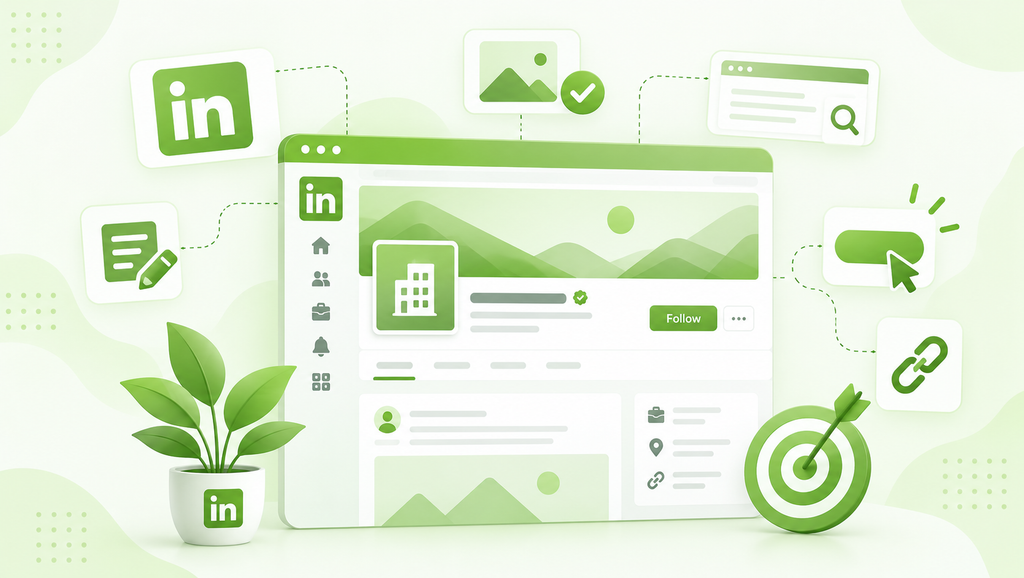
An incomplete or unprofessional company page gives a poor impression of your business. Give clear and concise information on the services your business offers and the market it caters to. Use relevant keywords to give a quick summary of the services you offer.
To give a professional touch to your business page, use your company’s logos and banners to give a complete and professional presentation. To enhance your business website, add a link and an accompanying call to action to encourage customers to learn more about your services or contact your employees.
2. Define Your Target Audience and Marketing Goals
If you know who your customers are, creating content to capture their interest is less of a daunting task. It is easy to identify the obstacles your customers face if you have a basic understanding of your market. Knowing your target audience helps you shape your strategies and messages to relay the solutions your business offers.
Establish goals for your content before sharing it. Common goals include raising the number of comments, shares, and likes on your posts; increasing the number of leads; improving the number of visitors to your website; and improving conversion rates. If your goals aren’t met after you measure your post’s performance, consider changing your strategy.
3. Create Valuable, Industry-Focused Content

The content you post should increase your followers and give them a reason to interact with your posts. Customers have many questions, and your posts should answer as many as possible. Your posts shouldn’t have to be promotional to be useful. At the end of the day, customers want to buy from companies that serve them best, and if your company can teach customers something new and relevant, they’ll develop a connection with your business.
There are numerous forms of content you can post to provide value to your customers. A few examples are:
- Posts explaining concepts and trends
- Posts giving step-by-step instructions
- Posts discussing changes and progress in your field
- Posts showing results and outcomes of your work
- Posts showing tips and ideas
- Posts showing data and research
Different forms of content can draw the attention of various users.
4. Use LinkedIn SEO to Improve Discoverability
To use LinkedIn SEO, you need to determine relevant keywords your customers use to describe your products or services. You can use these keywords to craft your posts. Using keywords also helps users searching for your competitors find you.
Your description of your company, your taglines, your posts, your articles, and your employee profiles are some of the places where you can work your best keywords.
Rather than simply repeating keywords, use them in a way that makes your writing normal and grammatically correct.
Writing that is optimized for LinkedIn and other social media sites can help your business reach people who are going to other sites to get info about your business.
5. Encourage Employee Advocacy
The information that your employees share about your business on their social media accounts can reach people who do not follow your business. The information your employees post can spark discussions and encourage other people to post and share your business information as well.
Suggesting what your employees can post is okay, but they should be free to share your business information as they see fit. A post about your business should not be shared simply to increase your business’s follower count. Employees should be encouraged to share their opinions when they post information about your business.
6. Build Relationships Through Engagement
There is more to LinkedIn marketing than posting updates. Use this opportunity to build user engagement with your prospects and clients, as well as with other professionals in your field. A good way to engage is to respond to comments on your posts. Furthermore, take the time to post thoughtful comments on updates related to your profession.
Of course, engaging in conversations related to your profession can help your clients and prospects see that you empathize with them. In the long run, developing professional relationships is the best way to build and maintain your business. While it may be tempting to turn your professional relationships into sales relationships, keep in mind that it is better to respond to a client’s or prospect’s concern with a useful reply before attempting to sell your product or service.
7. Use LinkedIn Ads for Targeted Campaigns
Although providing value through your marketing posts is a great way to help your target market and grow your business, LinkedIn provides an added service through LinkedIn Ads to help you connect to your market more directly. These ads allow you to promote your business, create offers, and drive leads.
When using LinkedIn Ads, you can choose from a variety of marketing options to ensure your ad reaches the right audience based on their job title and/or industry.
- Job title
- Industry
- Company size
- Location
Know your audience and goal. A client may want to experiment to learn the best combination of ad elements, like format and message, to reach the best audience. Continuously monitor your campaigns to avoid wasting money on bad audiences or creatives.
8. Track Performance and Refine Your Strategy
The main points of any successful marketing strategy are audience engagement and goal attainment. For marketing on LinkedIn, your focus should be less on superficial things like the number of likes and more on figures that move your business and inform audience behavior.
Examples of key metrics are:
- Impressions
- Engagement rates
- Followers
- Click-through rate
- Leads
- Conversions
Looking at these numbers helps you understand what your audience finds interesting. This should inform your content strategy. Poor-performing content should be adjusted or removed, and new content created to fill in the gaps in strategy.
Launch Your Website Today
No matter which path you choose, you need a strong hosting foundation to grow online. Get secure, fast, and beginner-friendly web hosting to power your digital journey.
Common LinkedIn Marketing Mistakes to Avoid
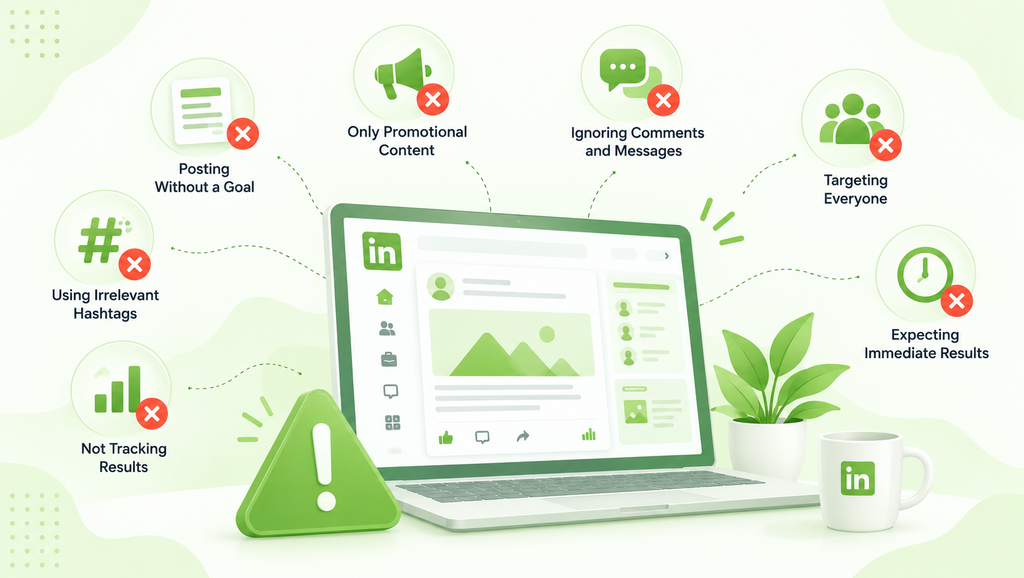
Marketing professionals make several routine mistakes when creating marketing content for LinkedIn. These include:
- Not having a defined objective for each post.
- Creating too much marketing content that results in a less useful business LinkedIn page.
- Not communicating with potential clients and prospects by not responding to their comments and/or messages.
- Not understanding their target audience and posting content for everyone.
- Using hashtags and/or excessive keywords that disrupt and detract from the normal flow of the content.
- Neglecting to review marketing tool performance data to assess and adjust marketing strategy.
- Believing that they need to achieve an immediate return on investment and/or expect to quickly gain thousands of followers.
How to Create a LinkedIn Marketing Strategy
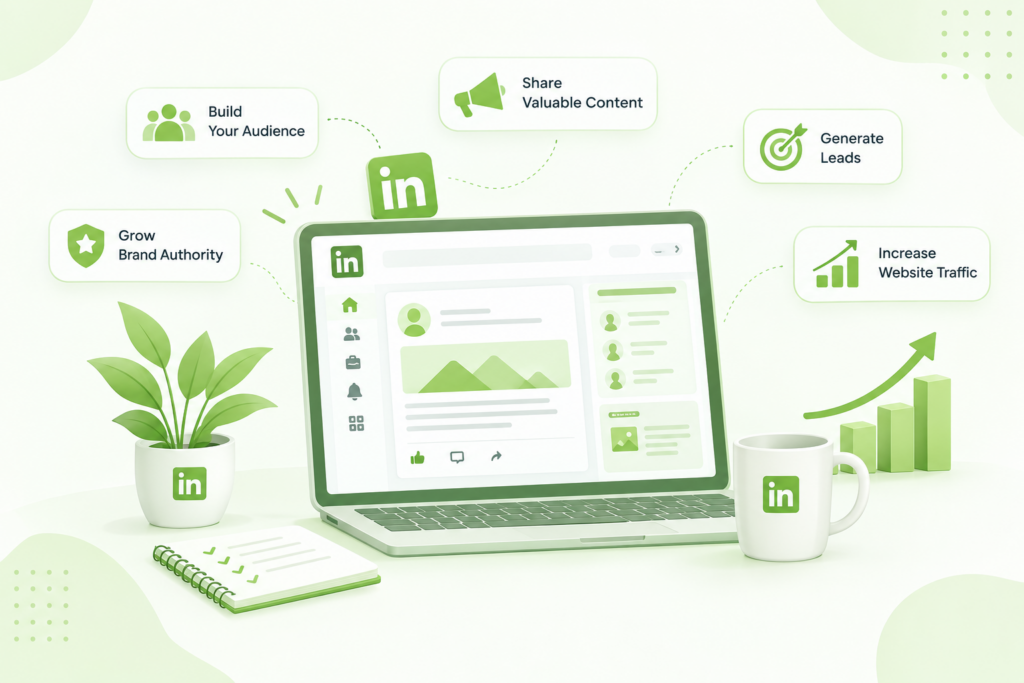
Designing an effective marketing strategy for LinkedIn can be simple. First, understand your business goals and your audience, and then build your strategy from there.
- Determining Marketing Goals: Decide what you want your digital marketing growth rate on LinkedIn to be, like creating brand awareness, generating leads, or increasing website visits.
- Identifying your Audience: Who are the people or businesses you want to achieve the marketing goals above with?
- Optimizing your Company Page: Add your business’s complete information for branding, description, and keywords. Include a relevant website.
- Developing a Content Plan: Plan the content you will post on LinkedIn.
- Posting and Responding: Post content and, in addition, share updates and comments from other users.
- Marketing with Paid Ads: Use LinkedIn marketing services to achieve your goals with paid ads.
- Looking at your Marketing Insights: Determine how well your marketing goals are achieved with LinkedIn by looking at updates and leads generated.
- Editing your Marketing Strategies: Modify your marketing strategies to achieve your goals with LinkedIn.
Conclusion
The best LinkedIn marketing campaigns utilize a variety of elements. The most effective campaigns integrate trackable elements to measure success and adjust their approach over time. Understanding your audience is crucial to developing helpful content. Consistency is of the utmost importance as well.
Use LinkedIn to build your professional network and gain valuable business insights. When coupled with effective SEO, the marketing and advertising strategies employed by your business will prove to be beneficial for years to come
FAQs
Is LinkedIn a good marketing channel?
Absolutely. The platform offers businesses numerous opportunities to build their brands and connect with professional and business service customers and clients.
What is the best way to create a LinkedIn marketing strategy?
Start by establishing your goals and identifying your audience. With this information, you can create an optimized company page. Make relevant content, interact with your audience, and assess the results of your efforts. With the achieved results, adjust your marketing strategy.
What is the most effective type of content to post on LinkedIn?
Content that is educational, contains statistics or research, or explains a process or case study is generally well-received. The type of content you post should be focused on your target audience and help achieve your marketing goals.
How much should a business post on LinkedIn?
The focus of your strategy should be the quality and relevance of your posts. If you can consistently create and post content that meets these standards, you should be able to achieve your marketing goals.
Is lead generation using LinkedIn marketing effective?
Yes, marketing on LinkedIn can be effective for lead generation. Writing and posting quality content, using LinkedIn’s promotion tools, and being end-to-end focused can all help marketing efforts to generate leads.
SMS Marketing: Boost Engagement & Improve Campaigns (2026)
By Festus Nkopuruk on July 14, 2025
Hostonce is the #1 WordPress Host
Ranked by 930+ customers in G2's Best Software Awards.
