

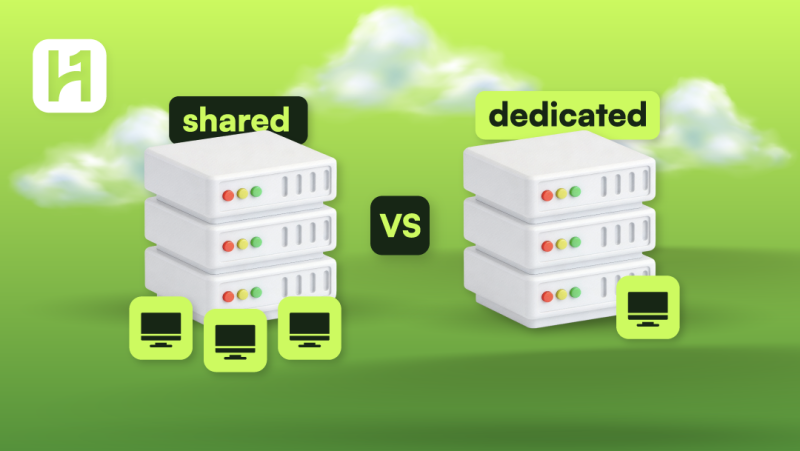
Web hosting supports more than 1.1 billion websites, of which 60% are on shared hosting, and 15% of the high-traffic, enterprise-level sites are on dedicated servers. With global website traffic growing 8-10% every year and with the reality that page load speed impacts conversions by as much as 32%, the stakes have never been higher when it comes to performance, security, and scalability. Therefore, choosing the correct type of hosting is invaluable.
Hosting of websites that are shared and dedicated are the most common types. These have different levels of speed, control, and availability of resources. Shared hosting is inexpensive and is perfect for people starting for the first time, low-traffic sites, and small businesses. On the other hand, Dedicated hosting is for enterprises, large e-commerce stores, and websites that need maximum customization and security, as it gives full power of the server. The range of hosting aligns more with your goals and growth, with an understanding of the differences.
Digital Marketing vs Affiliate Marketing: Which One Should You Choose?
By Javeria Riaz on May 26, 2026Key Takeaways
- Shared hosting is perfect for beginners and low-traffic sites.
- For high-traffic enterprise-level sites, use dedicated hosting for maximum performance and security.
- With shared hosting, the server resources are used by other users, while with dedicated hosting, you have an entire server to yourself.
- Dedicated servers outperform all types of hosting in terms of performance, speed, security, and scalability.
- Dedicated servers have all their resources available to a single client, and while their cost is high, the features available at that price point are very high.
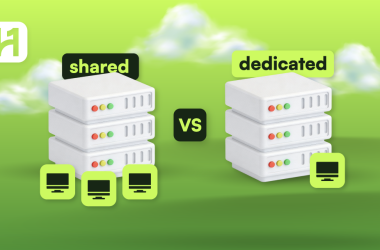
- Shared hosting is, as the name implies, hosting where a single server’s resources are served to a single user.
- The choice between the two varieties of hosting is based on the size of the website, expected traffic, security concerns, the technical ability of the user, and the cost, of course.
- Starting with shared hosting, then upgrading to a higher level of hosting is a common and generally more cost-effective growth path.
Shared Hosting is a type that allows multiple users to have their websites on the same physical server and have hosting resources split on the same server by CPU, RAM, bandwidth, and storage. Because more users are on the same server, the costs for the server are split among all users, and this way, the shared hosting plan costs the least.
How It Works

In shared hosting, your website runs on a server with dozens of other websites. All of the websites will be pulling from the same resources, the same processing power, the same RAM, and the same storage. This means that depending on the overall demand on the web server from the other users, your site will run slower or faster, but overall, the server and hosting remain affordable.
The hosting company provider executes all the technical processes, like managing the servers, handling upgrades, installing security patches, performing WordPress backups, and server security monitoring. This hands-off responsibility model makes shared hosting best for newbies or those who would rather not deal with server housekeeping.
Key Features
Shared hosting has numerous characteristics that contribute to its value and popularity for those who have little experience creating websites.
- Affordability: Given the fact that the server resources’ total compute power and bandwidth are split among many other clients, the total cost is incredibly low. This makes shared hosting the least costly option.
- Hassle-free Setup: You get to configure your shared hosting with one-click installers, guide wizards for workflows, and simplified dashboards. You have the ability to kick-start your website in minutes.
- No Technical Knowledge: You wouldn’t have to deal with server management, coding, or any other advanced stuff. The hosting provider does all that for you.
- Server Environment: You don’t have to manage any technical tasks; all you have to do is focus on building your website.

Ready to Launch Your Website the Smart Way?
Choose reliable, affordable hosting that grows with you. Start with Hostonce’s powerful shared hosting plans and get your website online in minutes.
Ideal For
Shared hosting is a great option for newbies. People building their first website or online store will value the low cost and ease in this simple environment.
- Small businesses: It is a great fit for local businesses and service providers and has many startups to help out with basic website requirements.
- Portfolios: Freelancers, creatives, and other professionals can showcase their work without an extensive financial commitment.
- Low-Traffic Blogs: Bloggers/content creators predicting low to moderate traffic can benefit from the affordability and accessibility of shared hosting.
What is Dedicated Hosting?
Dedicated hosting is the top-tier hosting option available. Here, your website is stored on a dedicated, single physical server, allowing you to receive fully devoted resources – CPU, RAM, storage, and bandwidth. Unlike shared hosting, which allows other websites to occupy the same server as you and competes with your website for resources, dedicated hosting allows for the greatest performance, stability, and customization.
How It Works
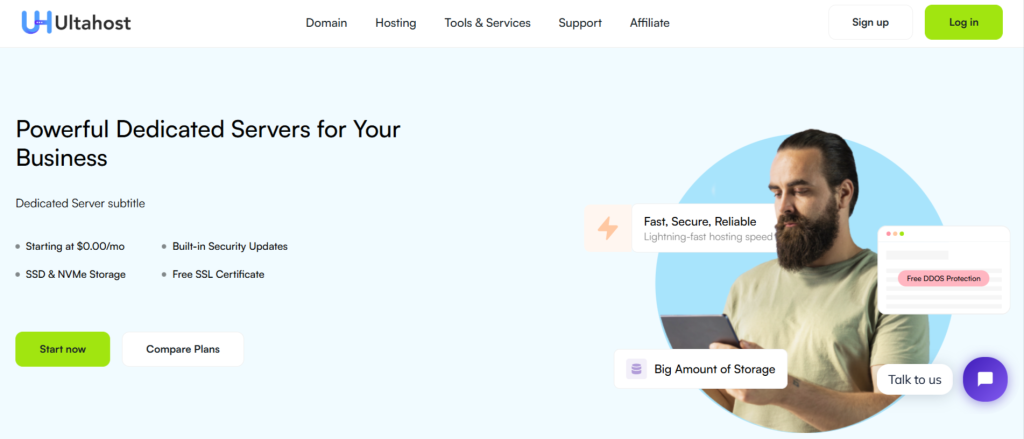
Dedicated hosting allows you to have complete command over your server. You have the freedom to customize the pieces of hardware you want, what software you install, and you can implement any measures of security you want. You can even go as far as fully customizing the security measures to the needs of your website.
With dedicated hosting, you have root or administrative access, meaning you can control the settings on an operating system level. This is what makes dedicated hosting the most suitable hosting option for big companies or developers that require advanced flexibility. Some hosting providers may offer managed support, but you decide all the inner workings of how the server behaves, including performance modifications and security changes.
Key Features
Dedicated hosting has an incredible set of features that is tailor-made for websites that require the highest level of control and performance from their hosting service. These features include:
- High Performance: As the single website that the server contains, dedicated hosting allows your website to maintain extremely fast load times, dependable performance, and stability while handling even the strongest of web traffic.
- Advanced Security: Full server isolation means your site isn’t affected by other users on your server. You are able to implement your own web application firewalls, encryption, intrusion detection systems, and compliance-level security.
- Root Access: With dedicated hosting, you get to have your own server, and with that, you get to have complete administrative access. You are able to configure the server at the OS level, install your own custom applications, and update however you wish.
- Custom Server Configuration: You get to choose your own hardware specs, operating systems, software stacks, and security tools. It ensures the server is optimized for your project.
Need Maximum Power and Performance?
Upgrade to a dedicated server built for speed, security, and full control. Perfect for high-traffic websites and demanding applications.
Ideal For
This hosting is the best option for dedicated businesses with:
- Enterprise Websites: Large and complex organizations are businesses that require top performance.
- High-Traffic Apps: Apps or platforms that have thousands of users and require seamless, uninterrupted access.
- E-commerce: Online shops that require secure transactions and that maintain sensitive customer data.
- Maximum Control: Platforms, web applications, and development environments that require custom root access and full network efficiency.
When determining which one to choose between the two, it boils down to the differences in performance, security, speed, control, and value. Below, we provide a side-by-side comparison to assist in determining which option best suits your website’s requirements.
Performance
When it comes to shared hosting, one of the major drawbacks is that your performance is affected. It is because your website is one of the many that share their server resources. If one site is experiencing a traffic surge, your site may slow down. Conversely, there is dedicated hosting, which employs uninterrupted performance since the server is solely used by your site. You are guaranteed consistent speed and stability, even in the event of heavy traffic.
Security
With shared hosting, the security of an individual website is lower because many other sites share the same environment. In the event of a vulnerability on one site, it poses a threat to others that share the same server. On the other hand, with Dedicated Hosting, there is complete isolation. It allows additional security options such as custom firewalls, DDoS protection, intrusion detection and containment systems, and compliance control that tends to geo-restricted access. This makes it a more robust solution ideal for sensitive and mission-critical sites.
Speed
The load on shared hosting depends on how many other sites are on your server. If there is an influx on other sites, your loading times could drop. However, with dedicated hosting, your allocated server is completely yours. It means your page loading times are much faster, and they remain that way because you don’t share with anyone.
Scalability
There is also more room to grow with dedicated hosting. Shared hosting has very strict limits on growth, which works well for smaller and developing sites, but as you grow, you run the risk of getting boxed in. Dedicated hosting allows you to grow as needed with your site. Moreover, you can increase CPU, RAM, storage, and bandwidth to meet your site’s requirements.
Control & Customization
Shared hosting will give you some minor room to adjust things on your website. However, you will never be allowed access to the deep settings of the server that you’re on. Dedicated hosting, on the other hand, is completely in your domain. You have the freedom to choose all the settings of the server, as well as the software you want to use. It gives you the freedom to control every detail of the environment.
Reliability
The inconsistency in the availability of shared hosting is a result of what is commonly called the “bad neighbor” effect. A more reliable form of hosting is dedicated hosting, in which consistent availability is guaranteed since your resources are not used by other websites.
Pricing
The low cost of shared hosting, which is great for someone on a budget and for simple websites, is a result of the costs being distributed to all other users. Those expecting a more sophisticated service are targeted by dedicated hosting, which is more expensive. Here, clients receive an entire server, better performance, more security, and full access, making it a popular option for businesses.
Still Not Sure Which Hosting Is Right for You?
Explore all hosting solutions and find the perfect match for your website’s needs — whether you’re launching a small blog or scaling a high-performance platform.
Quick Comparison Table
| Category | Shared Hosting | Dedicated Hosting |
| Performance | Limited due to shared server resources | High and consistent performance with dedicated resources |
| Security | Higher risk because multiple sites share the same environment | Stronger security with full server isolation and custom protection |
| Speed | Can slow down during high server load | Fast and stable speeds optimized by dedicated hardware |
| Scalability | Limited upgrade options | Highly scalable with flexible resource upgrades |
| Control & Customization | Basic control; no root access | Full root access and complete server customization |
| Reliability | Affected by other users (“bad neighbor effect”) | Very reliable with predictable uptime |
| Pricing | Budget-friendly and ideal for beginners | Premium pricing suited for demanding applications |
Being familiar with the characteristics of each form of hosting is advantageous in selecting the one that is best suited to your needs, budget, and objectives in the long run.
- Cost-effective: One of the cheapest hosting options available since resources are shared.
- Beginner-friendly: Built with non-technical users in mind.
- Hassle-free: Your hosting provider takes care of updates, security patches, and ongoing server maintenance.
- Easy to get started: Using one-click installers, launch your site in a matter of minutes.
- User-friendly dashboards: Control panel options like cPanel and Plesk are simple to use and organized.
- Pre-configured environment: There is no need to worry about setting software on the server or tinkering with server settings.
- Restricted resources: During busy times (website peak times), the loading times of your site and other sites on the server can slow down.
- Security risks: One compromised site on your server can put other sites in your shared hosting account at risk.
- No room for custom innovation: Software with restricted installation and no access to change the settings on the server.
- Restricted IT Traffic: Sites that are rapidly growing or get a lot of visitors are not a good fit for shared hosting.
- Risk of downtime: Other sites on the server that use a lot of server resources can impact your site’s uptime.
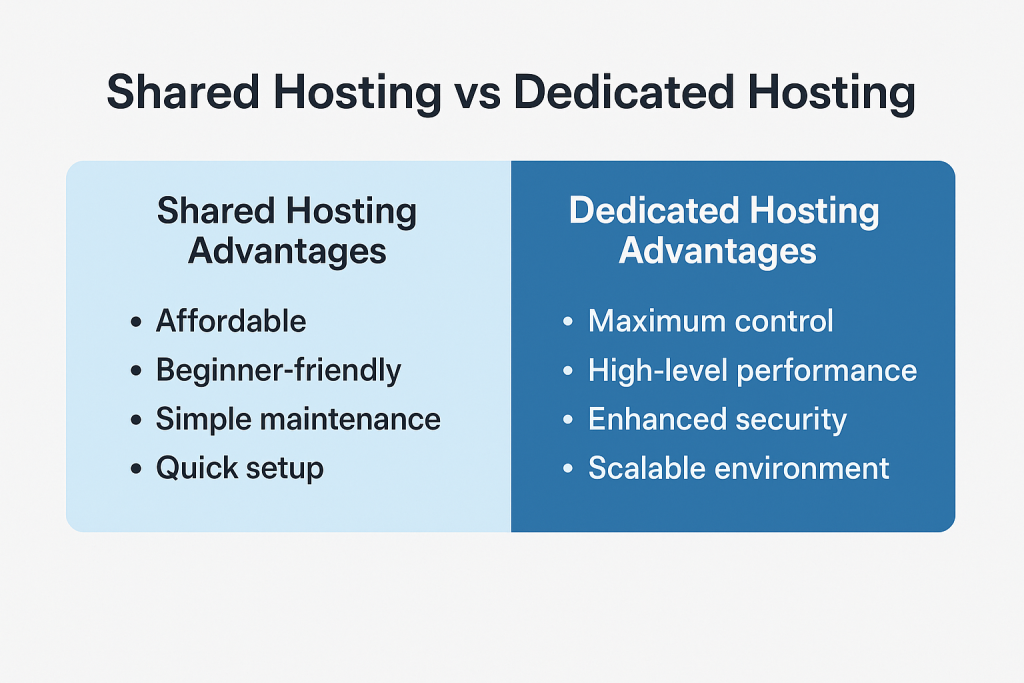
Dedicated Hosting Advantages
- Unparalleled access: Root access is provided to add any required software, change the operating system, and configure your server to your liking.
- Resource budget: Your site will never be under-resourced, as the CPU, RAM, and storage are exclusive to your website.
- Security risks: Complete relative isolation also helps reduce the risk of data privacy leakage, as well as other security risks that can affect sensitive data.
- Scalable environment: Upgrade hardware as your site requires more resources.
- Optimized speed: Gets fast response times since server resources are not shared.
- Custom software support: Run your own software, app, or frameworks that shared hosting does not support.
Dedicated Hosting Disadvantages
- Expensive: Higher monthly cost because you rent an entire server.
- Requires technical skills: Proper management may require server administration knowledge.
- More responsibility: You handle updates, monitoring, and configurations unless on a managed plan.
- Longer setup time: Custom configurations can take more time to deploy.
- Overkill for small sites: Not necessary for low-traffic or beginner websites.
Expert Tip
If you’re unsure whether to choose shared or dedicated hosting, start by evaluating your projected 12–18 month growth, not just your current needs. Begin with shared hosting if your traffic is low, but choose a provider that offers easy upgrades to VPS or dedicated servers. This ensures you avoid migration hassles later and gives your website a smooth, scalable path as your traffic, performance needs, and security requirements evolve.

Which One Should You Choose?
The decision of dedicated hosting vs shared hosting comes down to the type of your site, the budget, and future growth. Each will cater to a different type of user, and knowing where you sit will help you make the right choice for the future.
- You’re just starting: If you are creating your first website, blog, or portfolio, it is ideal.
- You have a website that gets a low to moderate traffic: Great for sites that get a regular, but predictable and not overwhelming, visitor traffic.
- You desire low cost and simplicity: Suitable for those who want a hassle-free and budget-friendly hosting option without technical headaches.
- You don’t need advanced customization: Great if you are okay with only basic functionalities and a few settings done in autopilot mode.
- You want a managed experience: The provider takes care of maintenance, security updates, and server upkeep.
Choose Dedicated Hosting If…
- You need high performance: Excellent for websites that need to load quickly and are guaranteed to always stay performant with no lags at any time.
- You run resource-heavy applications: Great for complex websites, large e-commerce stores, SaaS platforms, or apps that require a lot of processing power.
- You need strict security or compliance: Necessary for websites dealing with sensitive information. Such as financial websites, restaurant websites, enterprise portals, and websites in the regulated industries.
- You expect large traffic spikes: Crucial for websites that are highly visited or for those that tend to experience high traffic spikes during promotions or events.
- You need complete control: Best for developers and businesses who need custom setups, root access, and total flexibility on the server.
Final Verdict
When deciding between shared web hosting vs dedicated server, it’s important to remember that while dedicated hosting provides maximum functionality and control over all aspects of the server, shared hosting is much more affordable, user-friendly, and requires minimal effort to manage, making it an excellent entry point into the world of web hosting and a good fit for websites that are low to mid-traffic in activity.
In contrast, dedicated hosting provides full performance, control, and significant protection levels, resulting in a superior fit for larger enterprises and websites that receive a high volume of traffic, and projects that need individual tailoring of the hosting infrastructure.
Overall, dedicated vs shared hosting boils down to the user’s goals. Shared hosting is ideal for low-budget, simple websites or those that are just starting. If that’s not your case, and you rather need quickness, dedicated hosting is a more effective allocation of resources in the long-term perspective.
Don’t choose your hosting just based on price. Select your hosting based on your real, immediate needs for the website. Anticipate future hosting needs and choose the hosting that provides the most flexibility for the future. Good hosting provides real help for your project. It is the one that allows your project to adapt easily.
FAQ
How much traffic can shared hosting handle?
Shared hosting works best for low-to-moderate traffic, typically around 1,000–10,000 monthly visitors. If your traffic starts increasing or your site becomes slower, it’s a sign you may need a more powerful plan.
Do I need technical skills for dedicated hosting?
Generally, yes. Dedicated hosting requires knowledge of server management, software installation, and security configurations. If you don’t have these skills, a managed dedicated server is a better option.
Can I upgrade from shared to dedicated later?
Absolutely. Most hosting providers allow smooth upgrades as your website grows. You can start with shared hosting and move to VPS or dedicated hosting without losing data.
Is dedicated hosting worth the cost?
Yes, if your website demands high performance, strong security, and complete control. For small or beginner sites, shared hosting is usually enough and far more cost-effective.
Best Web Hosting: Top 10 Providers for 2026
By Javeria Riaz on October 11, 2025
Hostonce is the #1 WordPress Host
Ranked by 930+ customers in G2's Best Software Awards.