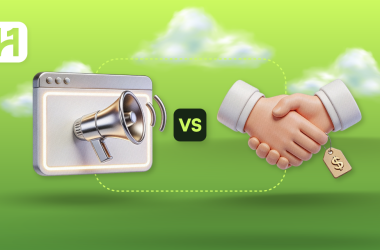



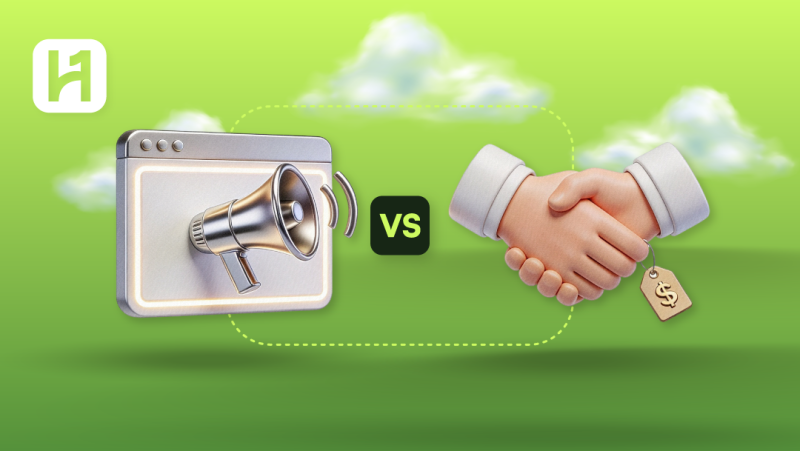
Digital marketing and affiliate marketing are both lucrative fields, as the global digital marketing industry is estimated to exceed $800 billion in 2030, and affiliate marketing is also on track for a $20 billion rise as companies adopt performance-based advertising. Since both fields use the same online traffic and user content, they are often confused by beginners.
However, they are actually very different. Digital marketing focuses on selling a company’s products via online channels, while affiliate marketing is commission-based marketing by selling other companies’ products.
VDS vs VPS Hosting – Which One Is Best For Your Business?
By Javeria Riaz on October 11, 2025Key Takeaways
- Digital marketing is about brand promotion and marketing itself, whereas affiliate marketing is commission-based and promotes other brands’ products.
- Digital marketing is broad and requires a lot more investment, but it is stable with consistent results.
- Affiliate marketing is more flexible, scalable, and low-cost at the beginning, but it usually takes more time to start making good money.
- Both are content-driven; both are about getting visibility and pulling traffic, but what they’re marketing and the structure of the income are different.
- Your goals, skills, time, and money will dictate what the best choice is, and there are a lot of marketers who mix both of them for better results.
What Is Digital Marketing?
Digital Marketing is a type of promotion that involves interacting and promoting to customers solicited through various online channels. Digital marketing involves “attraction” marketing, as customers can be solicited through search engines, social media platforms, and emails. and also through advertisements.
This activity is utilized by businesses, e-commerce, startups, online stores, agencies, and even individual self-employed creators who want to sell something online. With over 65% of customer interactions happening online, digital soliciting is a necessity now more than ever.
Core Components of Digital Marketing
- SEO: When a company desires to improve their presence over the various online platforms that can influence customer pull, they focus on effective and efficient utilization of search engines, on-page programming, and link building to ensure the success of customer retention.
- Social Media Marketing: This is using various social media platforms to market a product or service.
- Content Marketing: This is marketing through videos or other electronic media to educate customers, which can support the product being marketed.
- PPC: This is the payment attributed to a customer interacting with an online advertisement that is targeted to sell something.
- Email Marketing: Lead nurturing and getting customers to buy again involves sending strategic emails that include promotions and newsletters, as well as automated emails that trigger under defined conditions.
- Tracking and Automation: Performance tracking and repetitive marketing streamlining can be achieved through Google Analytics and other CRM and marketing automation software.

Start Your Online Journey
Whether you’re going into digital marketing or affiliate marketing, a fast and reliable website is your foundation. Launch your site today with high-performance WordPress hosting.
Digital Marketing: Pros & Cons
| Pros | Cons |
| Helps businesses grow through multiple online channels | Requires continuous learning due to algorithm updates |
| High-income career opportunities | Can be costly for businesses (ads, tools, experts) |
| Many specialties to choose from | Takes time to see measurable results |
| High demand across industries | Highly competitive field |
What Is Affiliate Marketing?
The commission-based income model in which persons market a business’s items and receive compensation for every transaction, lead scoring or action made via their individual associated link is known as affiliate marketing. Rather than producing their own product, affiliates concentrate on promoting items to an audience.
To begin an affiliate marketing business, a merchant must first establish an affiliate program. Then, an affiliate can join the program and begin marketing the product. When a consumer clicks on the affiliate link and makes a purchase, the affiliate receives a commission. These types of marketing strategies are cost-effective for businesses and help to earn flexible income for the creators.
Key Components of Affiliate Marketing
- Merchant: This is the brand or company that possesses the product or service. They establish the affiliate program and pay commission for successful conversion.
- Affiliate/Publisher: This is the marketer or individual who advertises the product on social media, YouTube, via email list, or on blogs and review websites.
- Tracking and Affiliate Networks: These are sites that link merchants to affiliates. These sites include Amazon Partners, Impact, and ShareASale. These sites are responsible for managing tracking links, analytics, commissions, payouts, and reporting to ensure commissions are correct.
- Generating Content and Driving Traffic: Affiliates develop and publish content by writing blog posts and producing videos, and social media content, as well as creating landing pages and advertisements, and try to persuade users to click on their affiliate links. Traffic can be generated through various forms, for example, through search engine optimization, social media, email, or other paid ads.
- Commission Models:
- Cost Per Sale (CPS): Affiliate earns a commission for every sale.
- Cost Per Action (CPA): Users complete a predetermined action, and the advertiser receives money (e.g., sign up, complete a form, etc.).
- Cost Per Lead (CPL): Affiliates get paid for producing a lead that is considered to be a qualified lead.
Launch Your Website Today
No matter which path you choose, you need a strong hosting foundation to grow online. Get secure, fast, and beginner-friendly web hosting to power your digital journey.
Affiliate Marketing: Pros & Cons
| Pros | Cons |
| Low or zero startup cost | Income not guaranteed |
| Potential for passive income | High competition in profitable niches |
| Flexible—no clients or deadlines | Algorithm-dependent growth |
| Scalable with blogs, funnels, and email lists | Payout delays and policy changes can affect earnings |
Digital vs Affiliate Marketing: Differences
For the companies involved, the online digital marketing and affiliate marketing opportunities and their results are very different in terms of aims, required skills, amount of investment, and income model.
Purpose
Helping a business improve its online visibility, attract and retain customers through online marketing and email digital strategies, social and search engines is the objective for digital marketing. The focus is to develop and enhance a brand measurably. Contrary to this, the focus of affiliate marketing is earning a commission for promoting the products of other companies. An affiliate does not develop a product. They solely drive retention/conversion through content and product recommendation.
Skills Required
Some of the many skills needed for digital marketing include SEO, PPC (Pay-Per-Click Marketing), strategy for social media, content coordination, marketing analytics, email marketing, and copywriting. It’s an all-encompassing field that needs an understanding of many marketing patterns. On the other hand, affiliate marketing needs specialized skills like niche selection, product research, SEO, social media growth, and persuasive content marketing. Digital marketing and affiliate marketing both need creativity. Digital marketing needs broader knowledge, while affiliate marketing needs more specific skills.
Income Potential
The income earned from digital marketing is predictable and stable. Other digital marketing skills can be freelanced or used in agency work, and the income earned increases as the digital marketer’s skills improve. Affiliate marketing is said to have a stable income because of its potential, or at least that’s the upside to it. Top affiliates are able to earn passive income, but it’s often inconsistent or slow results at the beginning, and that becomes a challenge for beginners. On marketing strategies, the niche selection and quality of traffic are the most important.
Expert Tip
If you’re unsure where to start, build foundational digital marketing skills first—like SEO, content creation, and analytics. These skills not only open the door to stable career opportunities but also significantly boost your success in affiliate marketing later. Mastering the basics of traffic generation and audience targeting gives you a major advantage in both paths.

Digital Marketing vs Affiliate Marketing: Comparison Table
| Category | Digital Marketing | Affiliate Marketing |
| Skills Required | Broad skill set including SEO, PPC, email marketing, analytics, content strategy, and social media management | Focused skills such as niche research, content creation, SEO or social media growth, and persuasive product promotion |
| Cost to Start | Moderate to high—tools, ads, and professional services can increase expenses | Very low—can start with a blog, YouTube channel, or social media account |
| Difficulty Level | More complex due to multiple specializations and ongoing learning | Moderate—mainly depends on content strategy and traffic building |
| Income Potential | Stable income through freelancing, jobs, or agency work grows with experience | High passive income potential but inconsistent; depends heavily on traffic and conversions |
| Time to See Results | Can be fast with paid ads; organic results take time | Usually slower—requires traffic growth and trust-building over months |
| Best For | Businesses, freelancers, career-focused marketers, and agencies | Creators, bloggers, influencers, side hustlers, and individuals wanting flexible online income |
Which One Should You Choose?
When deciding on digital marketing or affiliate marketing, the deciding factors include your goal, skills, time, and financial investment, as to which would be more beneficial to you. While both can be lucrative, each one gives you a different direction and lifestyle to carry on with.
Your Goals
For those who wish to have a long-term career and work with businesses, digital marketing would be the right fit, as it is stable and more lucrative in terms of career options. However, if it’s passive income you wish to earn without the hassle of managing clients or products, then content creation, and affiliate marketing can be a great fit.
Your Skills
Digital marketing requires a whole bunch of skills and is ideal for those who like learning different skills, for it requires those individuals to be skilled in analytics, ads, copywriting, SEO management, strategy, communication, and more. However, if one prefers to narrow their focus more to one speciality, affiliate marketing would work better as it requires content creation, product review, SEO, and social media marketing, while also being more focused.
Your Time
In the case of digital marketing, if you work with clients or run paid campaigns, it results in a more consistent, quicker income and better results. However, affiliate marketing vs SEO requires more time at the start, as its results are consistent income after you have built trust and traffic. If you are more patient and are willing to grow with it, affiliate marketing can work well for you, while if you need fast results, digital marketing is the better option.
Your Budget
Marketing for digital platforms often requires an investment in tools, courses, and software, as well as spending money on ads. For businesses and freelancers, these costs can be substantial. Affiliate marketing, in contrast, is more economical and can be started for little or no expense, so it is perfect for those with no money and very little experience.
Grow Online with Confidence
Take the next step toward building your digital presence. From hosting to tools that support your growth, Hostonce has everything you need to succeed—whether you’re starting a blog or scaling a business.
Personalized Recommendations
- If you are a beginner looking for an inexpensive and flexible marketing option, start with affiliate marketing. On the other hand, if you want a well-defined career path, go for digital marketing.
- If you are a student, affiliate marketing can be an excellent way to earn some money. If you would like to have some work, even if it’s just on an internship basis, within the marketing domain, digital marketing can work for you as well.
- If you are a freelancer, digital marketing will be a better option as it can provide you with a more stable and consistent income from client work. You may want to add affiliate marketing later on as a way to earn passive income.
- For entrepreneurs, digital marketing can help you create and grow your business, while affiliate marketing can be a channel to earn extra revenue. Many entrepreneurs find using affiliate marketing in addition to digital marketing to be very helpful.
Conclusion
Although both digital and affiliate marketing can involve similar methodologies, the end goals are different; one is centered around the development and marketing of a brand, while the other is centered around earning a commission through product recommendations. Digital marketing is a better fit for those seeking a more stable career and client work, or business growth, while affiliate marketing is more aligned with those desiring flexible, low-cost, and scalable income opportunities through content creation. Ultimately, the decision is about clarifying potential constraints with respect to vision, goals, time, skills, and budget.
FAQ
Can I start affiliate marketing with no experience?
Yes. Affiliate marketing is beginner-friendly, and many people start with just a blog or social media account. However, learning basic SEO or content creation will help you see faster results.
How long does it take to earn from affiliate marketing?
It usually takes a few months to start earning consistently because you first need to build traffic, trust, and content. Results depend on your niche, strategy, and audience.
What skills do I need for digital marketing?
Digital marketing requires a mix of SEO, social media management, content creation, analytics, email marketing, and sometimes paid advertising. You can learn these skills step-by-step.
Can I do both digital marketing and affiliate marketing together?
Absolutely. Many successful marketers use digital marketing skills—like SEO, content writing, and email marketing—to grow their affiliate income. Combining both can lead to higher earnings and more opportunities.
VPS vs WordPress Hosting: Which is Best for Your Website?
By Festus Nkopuruk on November 6, 2025
Hostonce is the #1 WordPress Host
Ranked by 930+ customers in G2's Best Software Awards.