


Websites tend to fail slowly rather than fail suddenly. Websites exhibit symptoms before total collapse, such as slow page load times, site outages during high traffic times, and occasional errors appearing on sight. A single second added to load times can lead to a steep 20% loss in conversion rates, and nearly 40% of visitors will abandon a site completely after just 3 seconds of waiting. As a site receives more traffic, there will come a point where shared hosting will bottleneck the site, leading to resource and bandwidth competition with dozens or more other sites on the server. This is the reason many businesses and online stores quickly tend to outgrow shared hosting without knowing why.
A Virtual Private Server (VPS) mitigates these frustrations by providing every site on the server with its own set of server resources and adjustable server security for more efficient and stable site operation. This section will outline five distinct signs that your website is ready for a VPS upgrade to ensure you make the necessary upgrades before your website begins to frustrate customers, traffic, and sales.
Why Choose VPS Hosting in Ireland: A Guide for Startups
By Javeria Riaz on October 12, 2025Key Takeaways
- Slow load speeds, increased downtime, and traffic issues are all signs of a website that has outgrown shared hosting.
- VPS hosting gives dedicated resources and control, coupled with better security for expanding websites.
- A surge in traffic, e-commerce transactions, and websites critical to business operations gain the most from the VPS uplift.
- Performance issues affecting user experience and conversion can be mitigated proactively.
- Right-sized VPS plan selection assures long-term peace of mind, stability, and scalability.
Table of Contents
- What Is VPS Hosting?
- Sign #1 — Your Website Is Getting Slower
- Sign #2 — Frequent Downtime or Server Errors
- Sign #3 — Traffic Growth Is Hurting Performance
- Sign #4 — Security Concerns Are Increasing
- Sign #5 — You Need More Control and Customization
- When Is the Right Time to Upgrade to VPS?
- Is VPS Right for Your Website Type?
- How to Choose the Right VPS Plan
- Final Thoughts
- FAQ
What Is VPS Hosting?
VPS (Virtual Private Server) Hosting is a hosting type in which a dedicated physical server is ultimately partitioned into several mini-virtual servers, such that each website is allocated a certain set of discrete resources in terms of CPU, RAM, and storage. Your resources in a VPS are also set aside from those of the other users within the same server. Because of the blend of control and reliability, VPS hosting is for sure the perfect solution for a growing website.
The most crucial aspect that separates a VPS from a shared host is the control and resources allocated. In a shared hosting environment, a plethora of websites vie for the same server resources. This piling up can introduce slower site speeds and can even lead to outages on your site in the event of a traffic increase. Using a VPS hosting system fully guarantees a private environment with unparalleled security, with root access, proper customizable security to meet your requirements, as well as adaptable resources to meet any traffic demand that might hit your site.

Upgrade to High-Performance VPS Hosting
If your website is showing the signs discussed above, it’s time to switch to a faster, more secure hosting solution. Hostonce VPS Hosting gives you dedicated resources, reliable uptime, and scalable performance to support your website’s growth without limitations.
VPS vs Shared Hosting: Comparison
| Feature | Shared Hosting | VPS Hosting |
| Resource Allocation | Shared among multiple websites | Dedicated CPU, RAM, and storage |
| Performance | Can slow down due to other sites | Consistent and stable performance |
| Traffic Handling | Limited; struggles with spikes | Handles high and growing traffic |
| Security | Shared environment, higher risk | Isolated environment with stronger security |
| Server Control | Very limited access | Full or root-level control |
| Custom Software | Usually not allowed | Fully customizable |
| Scalability | Minimal or restricted | Easy to scale as needs grow |
| Best For | Small sites, beginners | Growing websites, businesses |
Sign #1 — Your Website Is Getting Slower
Increased website load times after optimizing your website, image caching, and using CDN services can be indicative of issues with your hosting provider. On shared hosting, multiple different websites compete for the same CPU and RAM resources, so if one website experiences a spike in traffic, your site’s performance will be impacted too—even if your own website is heavily optimized for performance.
To improve inadequate performance levels, some hosting providers may implement VPS, a hosting service that improves site speed by altering the speed of Hosting. In better VPS models, sites are able to acquire a greater number of guaranteed CPU performance, RAM, and faster storage, so that their webpages are able to load more quickly from server-responsive times for site performance, while also being able to handle heavier workloads.
Sign #2 — Frequent Downtime or Server Errors
If you regularly make 500 Internal Server Errors, time-out messages, or random site crashes, this is a common sign that you have outgrown your shared hosting. In these scenarios, your website becomes completely inaccessible. If this time trouble affects your normal traffic peak times, your server resources are stretched too thin, resulting in an unstable website—a common warning if shared hosting becomes unmanageable.
In VPS services, your website operates in an isolated environment, so traffic spikes or hosting issues from other misconfigured accounts on the server don’t affect your site. Isolated VPS hosting services or plans can have a greater overall service impact and are typically favored by customers for high uptime, which is very important for online stores.
Sign #3 — Traffic Growth Is Hurting Performance
More traffic should mean more revenue – but if your site is on a shared hosting plan, more visitors mean less page speed, failed transactions, and more server crashes. This is especially critical during flash sales and viral moments, when shared servers can’t scale and handle the load.
A VPS is designed to handle growth more than shared hosting. It allows you to increase the resources on your site, like CPU, RAM, and hard drive space, meaning your site won’t slow down during peak traffic times like flash sales and holiday seasons. This makes VPS perfect for growing brands, content-focused sites, and e-commerce online stores.
Need More Power? Choose VDS Hosting
For websites that demand even higher performance and resource isolation, Hostonce VDS Hosting delivers enterprise-level speed, stability, and control. It’s ideal for high-traffic projects, large databases, and resource-intensive applications.
Sign #4 — Security Concerns Are Increasing
Because of the nature of shared hosting, you are more exposed to serious security threats such as DDoS attacks. This is because you are sharing the same server with multiple websites. This is extremely dangerous if any of the websites are compromised, as your site is then exposed to the same vulnerabilities.
VPS Hosting makes security easier by giving you your own isolated server, meaning you are less likely to be a victim of serious attacks on your website. VPS also gives you more control and the ability to implement certain security measures, like firewalls and malware protection. This is perfect for e-commerce sites, websites with sensitive client data, and for more data-intensive applications.
Expert Tip
Don’t wait for consistent downtime or major slowdowns before upgrading. Monitor your server’s CPU, RAM usage, and page load times regularly — if resource usage stays above 70% during normal traffic, it’s a strong signal that moving to a VPS will improve performance and protect future growth.

Sign #5 — You Need More Control and Customization
There come the growing pains of your website hosting and your shared hosting service. You’re looking for additional bandwidth and custom configurations, only to discover your hosting service has limits on what can be added, what can be installed, and what can be modified on the server side. This lack of flexibility in the hosting service becomes restrictive for those needing custom software, advanced server configurations, and particular app directives.
In the case of shared hosting, there is none of that. VPS (Virtual Private Server) hosting grants the user root access to fully control the server environment. This means the user can install additional software and make changes to customize the server to meet the exact publishing and performance requirements of the user. That’s what developers, agencies, and growing companies need.
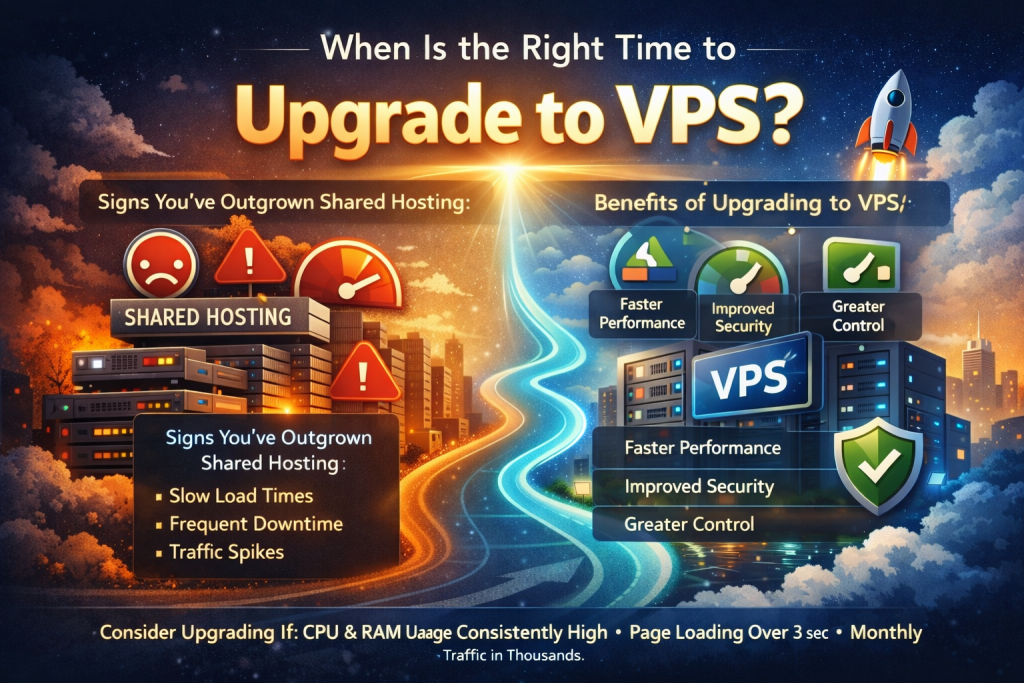
When Is the Right Time to Upgrade to VPS?
If you upgrade too soon, you may end up paying for resources you don’t completely need, but upgrading too late may be even more detrimental. For example, the longer you wait to upgrade to a VPS, the more you may face slow site loading times, more downtime, lost site visitors, and fewer conversions due to decreased performance. Over time, these issues can cause even more damage to the performance of your site, your SEO optimization, and even your brand reputation. If you start experiencing performance-related issues that impact user experience or sales, and you do not upgrade to a VPS, you will be paying more for the other issues than the cost of the VPS hosting.
In the event that your website is consistently experiencing strong growth, needs to have more advanced security and customization due to regularly or constantly hitting performance downtime during peak times, or is experiencing other performance issues, that is the ideal time to switch to a VPS. If you are planning a website for a new eCommerce store, managing multiple other sites, or planning for more advanced campaign traffic management, that is the right time to upgrade too. VPS hosting is a smart, long-term investment that will pay for itself over time due to the better hosting options.
Is VPS Right for Your Website Type?
- Blogs and Content Sites: VPS is perfect for your new blog if it has steady or viral traffic, is resource-heavy (images, videos), or monetizes with ads and SEO. Having dedicated resources ensures your pages will load quickly and won’t suffer slow load times during traffic spikes.
- Business Sites: There is better performance, downtime, and security for business-critical pages, lead forms, and integrations for a VPS. This is a good option as your brand matures and traffic becomes more predictable.
- E-Commerce Stores: With VPS hosting, product pages load quickly, transactions are secured, and checkouts are completed seamlessly. This is especially important for flash sales, seasonal spikes, and compliance with regulations surrounding payments.
- Agencies and Developers: VPS server upgrade provides unparalleled control and custom setups, as well as the ability to host numerous client projects. This is especially great for development and staging environments, as well as scaling client sites with no resource restrictions.
How to Choose the Right VPS Plan
To determine the most suitable upgrade VPS Plans to choose from, you should begin by looking at the CPU, RAM, and storage. Moreover, assess what your website requires based on how much traffic is expected to come to the site. If your website is a content or a small enterprise website, the RAM should be enough to cater to what the plugins and the cache need. But, for e-commerce sites or highly trafficked sites, the CPU cores should be a lot more to allow faster caching and CPU processing. Another consideration to make is the storage type. SSD or NVMe storage improves performance with faster load times compared to traditional HDDs. It is important for better performance in databases.
Launch Your Website Today
No matter which path you choose, you need a strong hosting foundation to grow online. Get secure, fast, and beginner-friendly web hosting to power your digital journey.
At this point, you should be able to make a decision to go with a managed or unmanaged VPS. If you don’t want to have to do server maintenance, you would prefer a Managed VPS. If you want a better price and more control, you would go with an unmanaged VPS. The only downside to this is that you would need some technical expertise. These types of VPS plans require you to manage the server yourself.
Lastly, make sure to go for a VPS that prioritizes good customer service and reliable uptime. Strong uptime and 24/7 customer service are important as it keeps your website secure and working properly at all times. Especially in times of a lot of traffic or when problems arise unexpectedly.
Final Thoughts
Is your website slowing down? Experiencing regular downtime? Having issues with growing traffic? All these are indicators that your website is outgrowing your shared hosting plan. With these issues unanswered, your website has the potential to frustrate users and lose many potential buyers. This is also damaging your website’s reputation.
So, when to upgrade VPS? The decision to upgrade to a VPS hosting plan should be a website owner’s first move. Therefore, it’s not something to be done out of desperation once the problems are too deep. If upgrading to a VPS hosting plan is done promptly, that guarantees the website owner the security, site performance, and ability to grow that they deserve, while also being able to provide a site experience that doesn’t frustrate users.
FAQ
How much traffic requires a VPS?
There’s no fixed number, but if your site consistently receives thousands of monthly visitors or struggles during traffic spikes, a VPS is usually the right choice.
Will VPS improve SEO?
Indirectly, yes. Faster load times, better uptime, and improved user experience from VPS hosting can positively impact search rankings.
Can I upgrade to VPS without downtime?
In most cases, yes. Many hosting providers offer seamless migration tools or managed upgrades with minimal to zero downtime.
Is managed VPS worth it?
If you don’t want to handle server maintenance, security updates, and monitoring yourself, a managed VPS is absolutely worth the extra cost.

Improving VPS Performance And Database Optimization
By Aliza Irfan on June 22, 2026
Hostonce is the #1 WordPress Host
Ranked by 930+ customers in G2's Best Software Awards.